Electron Capture Detector
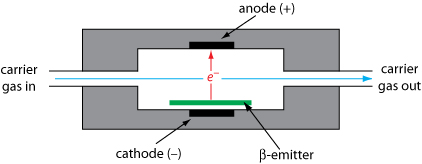
Shown here is a schematic diagram of electron capture detector (ECD) for gas chromatography. The detector consists of a β-emitter, such as 63Ni. The emitted electrons ionize the mobile phase, which is […]

Shown here is a schematic diagram of electron capture detector (ECD) for gas chromatography. The detector consists of a β-emitter, such as 63Ni. The emitted electrons ionize the mobile phase, which is […]
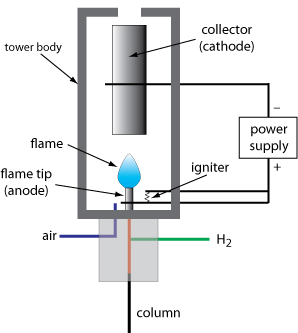
The schematic diagram below shows a flame ionization detector for gas chromatography. The eluent from the column mixes with H2 and is burned in the presence of excess air. Combustion of organic […]
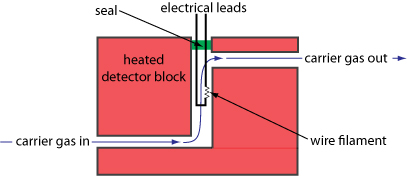
One of the earliest gas chromatography detectors takes advantage of the mobile phase’s thermal conductivity. As the mobile phase exits the column it passes over a tungsten-rhenium wire filament (see figure below). […]
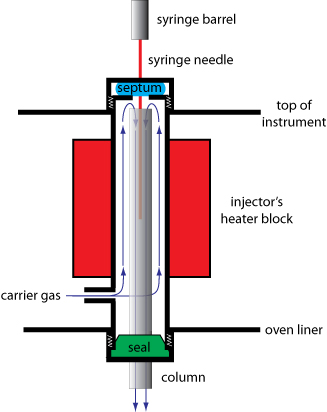
Shown here is a schematic diagram of a heated GC injector port for use with packed columns. The needle from the syringe pierces a rubber septum and enters into the top of […]
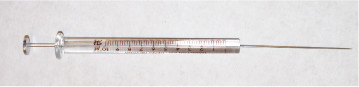
Shown here is an example of a syringe for injecting samples into a gas chromatograph. This syringe has a maximum capacity of 10 μL with graduations every 0.1 μL.
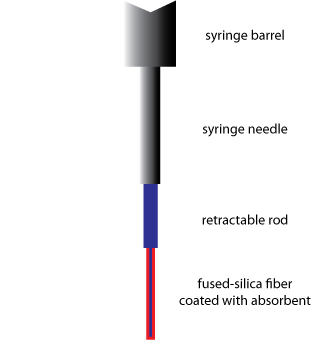
Solid-phase microextraction (SPME) is an attractive method for isolating an analyte prior to injecting it into a gas chromatograph. In one approach, which is illustrated here, a fused-silica fiber is placed inside a […]
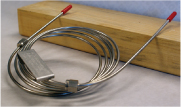
Shown here is an example of a packed column for gas chromatography. This column is made from stainless steel and is 2 m long with an internal diameter of 3.2 mm. The […]
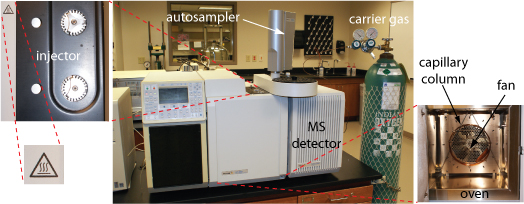
Photograph showing an example of a typical gas chromatograph with insets showing the heated injection ports—note the symbol indicating that it is hot—and the oven containing the column. This particular instrument is […]
One way to improve a separation is to decrease the height of a column’s theoretical plate. The figures here consider four contributions to plate height: variations in paths length, longitudinal diffusion, mass […]
The illustration below shows how the mobile phase pH in liquid chromatography affects our ability to separate a mixture of four substituted benzoic acids. The retention times in (a) suggest there are many […]
Adjusting the retention factor to improve the resolution between one pair of solutes may lead to unacceptably long retention times for other solutes. For example, suppose we need to analyze a four-component […]
The ideal chromatographic peak has a Gaussian profile, which occurs if the solute’s partition coefficient, KD, between the stationary phase and mobile phase KD = [S]s/[S]m is independent of the solute’s concentration. If this […]