
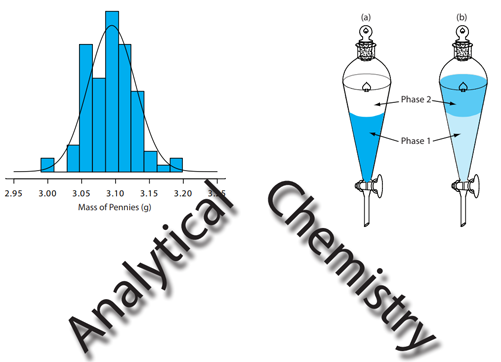
Analytical Chemistry 2.1 provides links to several resources for undergraduate education in Analytical Chemistry, including Resource Developed by: Dr. David Harvey, Depauw University, harvey@depauw.edu Active Learning Exercises to Accompany Analytical Chemistry 2.1 Developed […]
Textual Material
Open textbooks, e-modules and supporting text for the Active Learning collection, written and classroom-tested by analytical chemistry educators.

This project provides students with a guided introduction to several topics of importance to the analysis of data; these are the: uncertainty inherent in measurements and how that uncertainty affects results importance […]
A series of collaborative learning activities and accompanying text that develop chemical equilibrium, including acid-base chemistry, formation of water-soluble complexes, and solubility are provided. These activities are intended to be done in […]
This e-module provides an introduction to the analytical chemist on the following topics: The significance of signal and noise in chemical measurements The origin of noise in chemical measurements How noise degrades […]
A series of collaborative learning activities and accompanying text that develop the areas of molecular and atomic spectroscopy is provided. Chapters on basics of spectrophotometry, ultraviolet/visible absorption, molecular fluorescence, infrared, Raman and […]
This module discusses basic concepts related to Lasers. Lasers are light sources that produce electromagnetic radiation through the process of stimulated emission. Laser light has properties different from more common light sources, […]
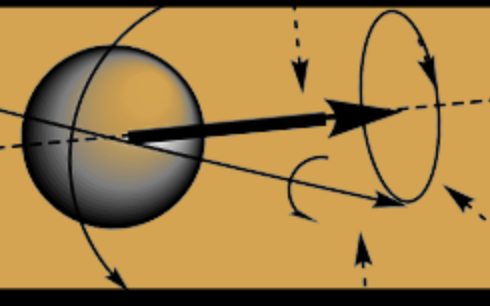
Introduction The goal of this unit is to develop introductory concepts on nuclear magnetic resonance (NMR) spectroscopy that are most relevant for undergraduate chemistry majors. Development of the concepts of NMR is […]
An online text on the basics of Nuclear Magnetic Resonance (NMR) spectroscopy. The text contains information especially appropriate for the novice, but topics are treated at sufficient depth to be useful for […]
Quantitative nuclear magnetic resonance (Q-NMR) measurements are especially useful for analysis of complex samples where high specificity is needed or when a pure standard of the analyte is not available. Often the […]
This module provides an introduction to Atomic Emission Spectroscopy (AES). AES is a broad area that includes several analytical chemistry techniques focused on elemental analysis, the identification, quantification, and (sometimes) speciation of […]
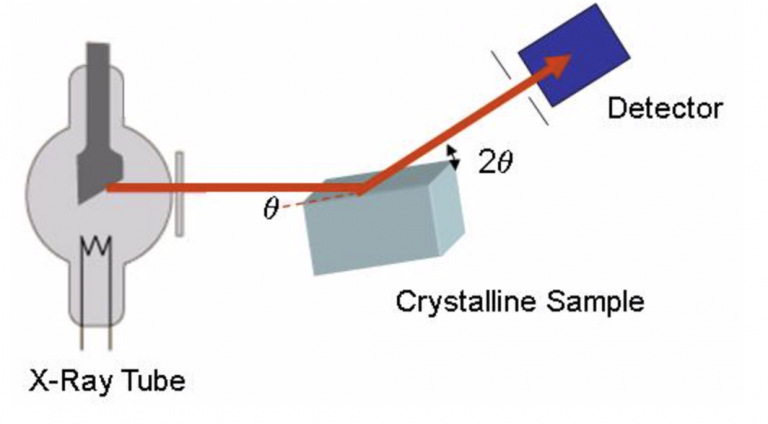
[vc_row][vc_column icons_position=”left”][vc_column_text]This module provides an introduction to X-ray Diffraction (XRD). XRD is a versatile, non-destructive technique that reveals detailed information about the chemical composition and crystallographic structure of materials. It is utilized in a variety of […]
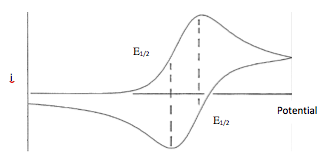
Introduction A series of collaborative learning activities and accompanying text that develop fundamental aspects of electrochemistry and electrochemical methods of analysis. These activities are intended to be done in class by students […]