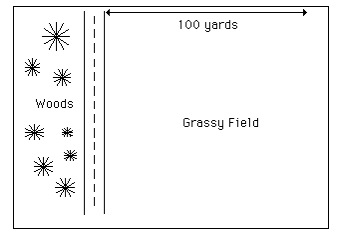
When leaded gasoline was available, automobiles were a significant source of the total yearly environmental emission of Pb. During internal combustion lead in gasoline, which was present as tetraethyl lead, was vaporized. The lead, now present as Pb0, adsorbed to small aerosol particulates, which were then released with the exhaust. Eventually these particulates settled out as “dry rain,” and were incorporated in local soils. One of the ways that this source of pollution was identified was through studies showing that the concentration of Pb in soils near highways decreased with distance from the highway.
(a) Suppose you are involved in a study to determine the effect of leaded gasoline on lead in the environment, and that you are to design the sampling plan. Your first task is decide where to collect samples. Shown below is a map of the area from which you are planning to collect samples. You are limited to six sampling locations due to time and budget constraints. Which of the six sampling strategies (random, systematic, judgmental, systematic/judgmental, stratified or convenience) would you use to select your sites. Please note that more than one strategy may be appropriate, but that some strategies are clearly inappropriate. Show, using X’s, where you might place these sampling locations, being sure that your locations are consistent with your sampling strategy.

(b) After selecting your sampling locations, the next step in the sampling plan is to determine whether the collection of samples, or the subsequent analysis of the samples will limit your study’s overall precision. Four replicate 1.0-g samples of soil are collected from a single location and analyzed for Pb, giving results of 5.09, 6.29, 6.64 and 4.63 ppb. When a NIST standard soil sample was analyzed by the same method the concentration of lead was found to be 11.49, 11.57, 11.72 and 11.77 ppb. Using these results, report estimates for the standard deviation due to sampling and the standard deviation due to the method.
(c) The next step in the sampling plan is to determine the sample size needed to obtain results of acceptable precision. Although the concentration of Pb may vary significantly from location-to-location, the soil at any single location is reasonably homogeneous. Using the information given above, what size samples should be collected if you want the relative standard deviation due to sampling to be 5%?
(d) The final step in the sampling plan is to determine the number of samples to collect at each location, and the number of replicate analyses to perform on each. Assuming that you are looking to achieve results with a relative error of no more than ±3%, what is the minimum number of samples that you should collect from each location? Is there a need to analyze any single sample more than one time? Explain.