Gravity Filtration
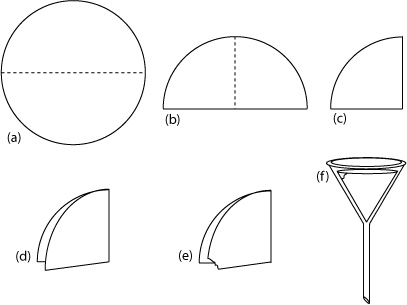
Illustration showing how to prepare a filter paper cone for gravity filtration. The filter paper circle in (a) is folded in half (b), and folded in half again (c). The folded filter […]

Explore resources, experiments, and teaching materials shared by the analytical sciences community.
Illustration showing how to prepare a filter paper cone for gravity filtration. The filter paper circle in (a) is folded in half (b), and folded in half again (c). The folded filter […]
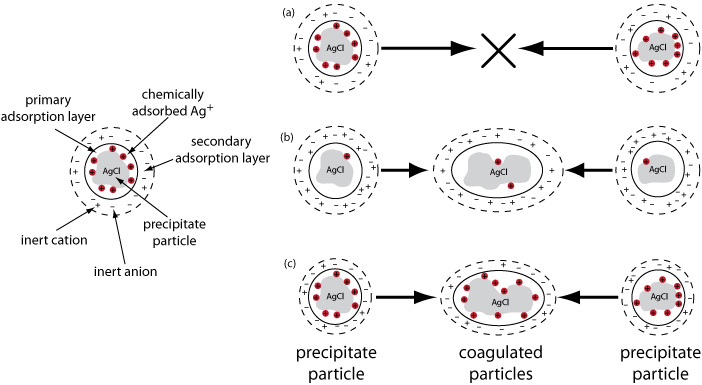
Two methods for coagulating a precipitate of AgCl are illustrated here: (a) because of electrostatic repulsion, coagulation will not take place if both particles are positively charged; (b) decreasing the charge within […]
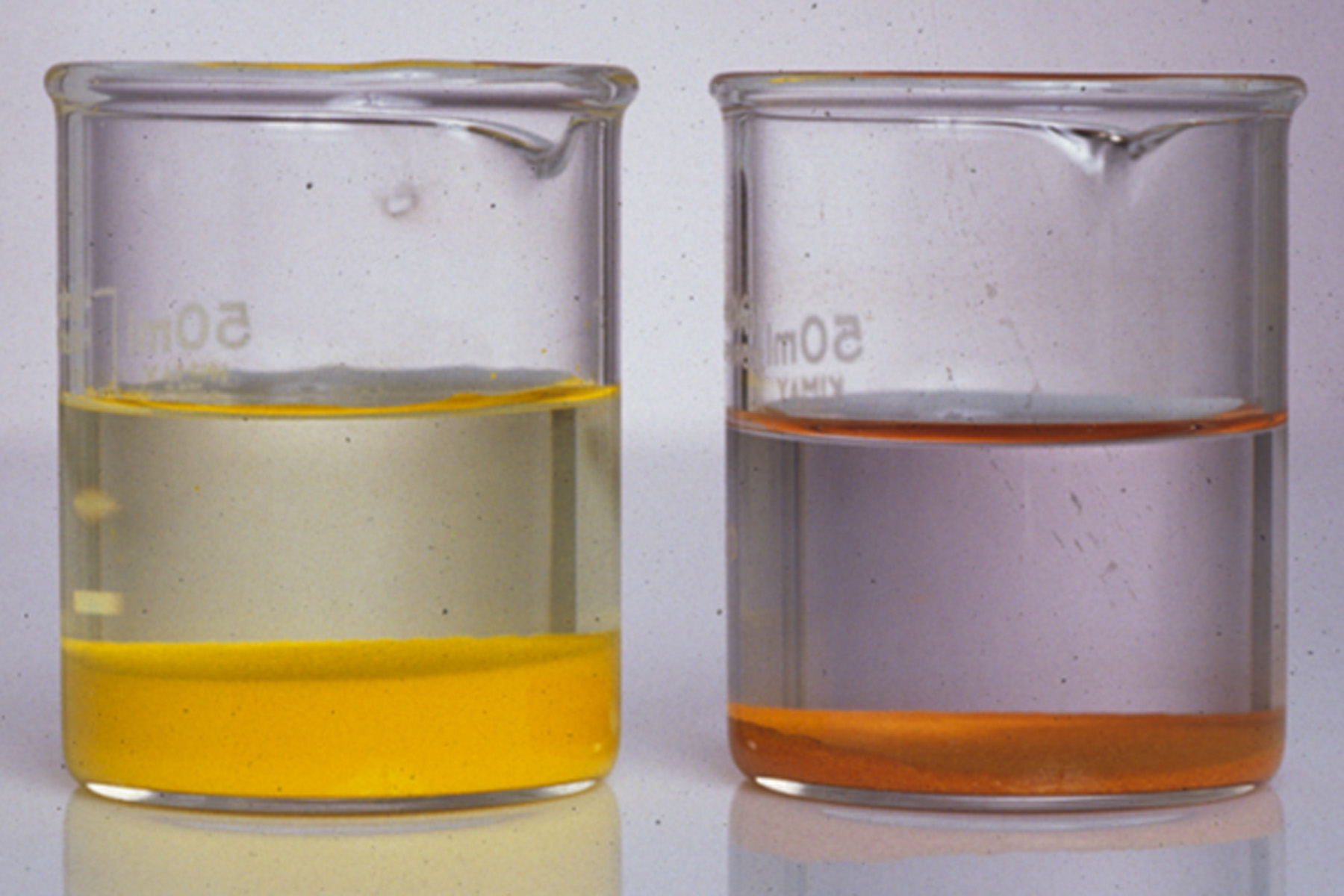
Two precipitates of PbCrO4 are shown in this photo. The precipitate in the beaker on the left was formed by pouring quickly a solution 0.1 M Pb(NO3)2 into a solution of 0.1 M […]
Mixing solutions of 1.5 M KNO3 and 1.5 M HClO4 produces a white precipitate of KClO4. If permanganate ions, MnO4–, are present, an inclusion of KMnO4 is possible. Impure precipitates of KClO4 […]
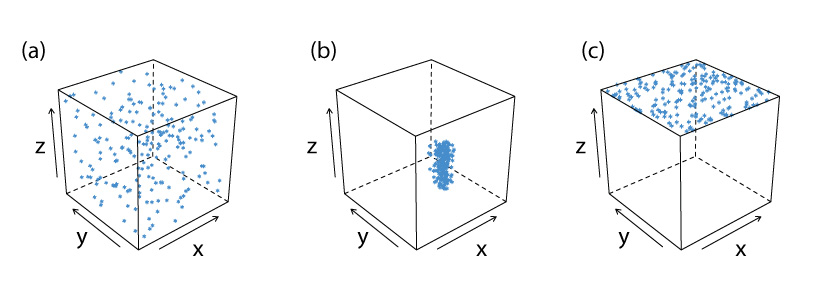
Three examples of impurities that may form during precipitation. The cubic frame represents the precipitate and the blue marks are impurities: (a) inclusions, (b) occlusions, and (c) surface adsorbates. Inclusions are randomly […]
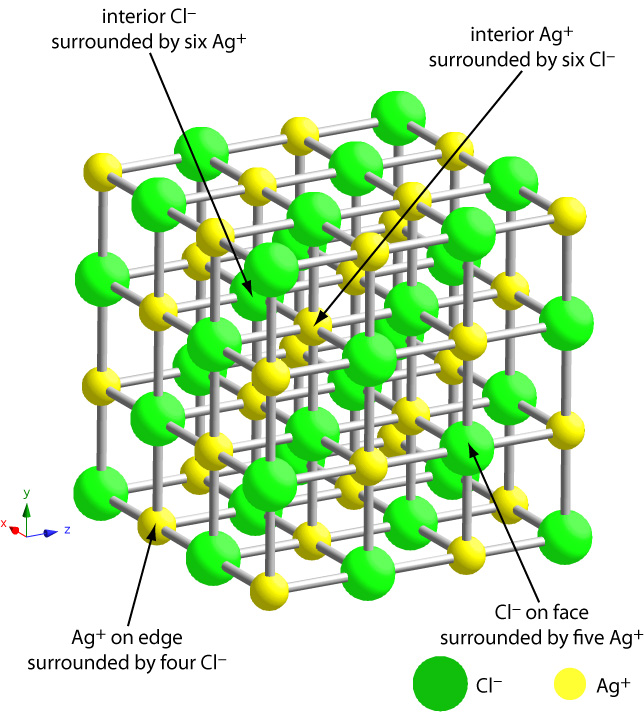
Ball-and-stick diagram showing the lattice structure of AgCl. Each silver ion in the lattice’s interior binds with six chloride ions, and each chloride ion in the interior binds with six silver ions. […]
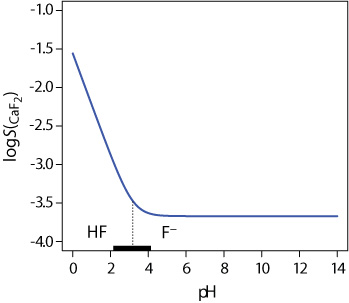
Illustration showing the solubility of CaF2 as a function of pH, represented by the solid blue curve. The predominate form of fluoride in solution is shown by the ladder diagram along the […]
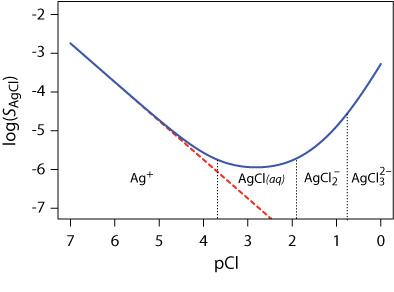
Illustration showing the solubility of AgCl, SAgCl, as a function of pCl. The dashed red line shows SAgCl if one assumes incorrectly that the only relevant reaction is AgCl(s) ↔ Ag+(aq) + Cl–(aq) The solid […]
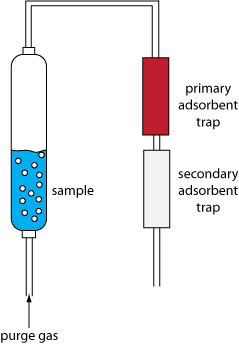
Schematic diagram of a purge-and-trap system for extracting volatile analytes. The purge gas releases the analytes, which subsequently collect in the primary adsorbent trap. The secondary adsorption trap is monitored for evidence […]
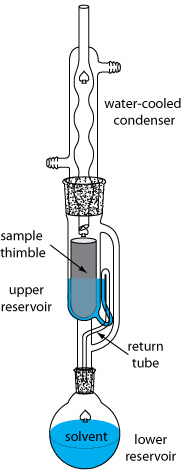
In a Soxhlet extraction, the extracting solvent is placed in the lower reservoir and heated to its boiling point. Solvent in the vapor phase moves upwards through the tube on the far […]
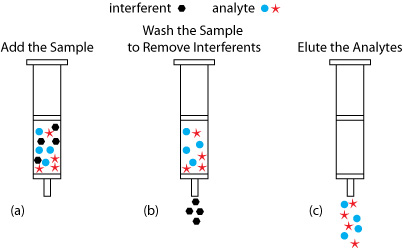
In a solid-phase extraction of a liquid sample, we pass the sample through a cartridge containing a solid adsorbent. A typical separation is illustrated here. Before adding the sample, the solid phase cartridge […]
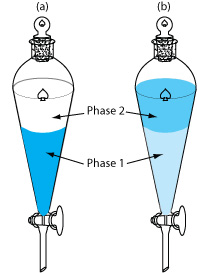
Illustration showing a liquid–liquid extraction using a separatory funnel: (a) before the extraction, 100% of the analyte is in phase 1; (b) after the extraction, most of the analyte is in phase […]