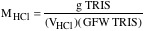
Calculating HCl Molarity and Titration Error
In determining the concentration of HCl by titrating against the primary weak base TRIS, the molarity of HCL is calculated using the following equation where GFW is the gram formula weight of […]

Explore resources, experiments, and teaching materials shared by the analytical sciences community.
In determining the concentration of HCl by titrating against the primary weak base TRIS, the molarity of HCL is calculated using the following equation where GFW is the gram formula weight of […]
Errors effecting analytical work are broadly classified as determinate or indeterminate. Briefly explain the difference between a determinate and an indeterminate error, citing at least three important ways which in they are […]
A glucometer is a portable device used to monitor glucose levels in blood. Of concern for users is repeatability between units of the same model, or between different models. The following data […]
One concern in any analysis is the impact of the sample’s matrix. A method for an analyte that is known to work well in one matrix may yield problems when applied to […]
Concentrated HCl is 37.2% w/w HCl (±0.5% w/w) and has a density of 1.19 g/mL (±0.01 g/mL). Suppose that you need to dispense 0.0500 mol of HCl with an uncertainty of no […]
Suppose you have a bottle of 53.4% w/w NaOH (the density of which is 1.52 g/mL) from which you are to prepare a 1.000-L solution of 0.534 M NaOH. Two obvious ways to […]
During lab you need to prepare a solution that is 5.00 x 10⁻² M Fe(CN)63- using K3Fe(CN)6. (a) Explain how to make 500 mL of this solution so that you know its […]
Parathion, C10H16NO5PS, is a toxic organophosphorous pesticide. A recently published method [Sacks, et al. Anal. Chem. 2000, 72, 2055-2058] for parathion reports a detection limit of 10 ng/mL. Express this concentration in […]
Milk of Magnesia, or MOM, is a suspension of Mg(OH)2. One method for determining the amount of Mg(OH)2 in MOM is to precipitate the Mg2+ as MgNH4PO4. Because this precipitate includes a […]
In an editorial published in American Laboratory (November 2000), Ira S. Krull states that in “any science, then, one must present at the very outset evidence of repeatability, reproducibility, accuracy, and precision […]
Gratzel et. al. [Anal. Chem. 1999, 71, 2751-2756] describe the use of a diffusional microburet to transfer solutions to very small droplets of solvent. The purpose of their work is to run […]
As part of the study of how humans age, there is an interest in learning how the chemical composition of tissues change as we grow older or as the result of disease. […]