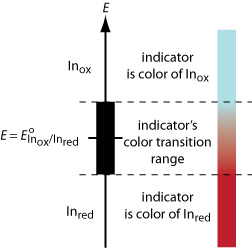
Selecting an Indicator for a Redox Titration
The most important class of indicators for redox titrations are substances that do not participate in the redox titration, but whose oxidized and reduced forms differ in color. When we add a […]

Get a look at images, photos, videos, and animations that encompass many facets of teaching and learning about analytical chemistry.
The most important class of indicators for redox titrations are substances that do not participate in the redox titration, but whose oxidized and reduced forms differ in color. When we add a […]
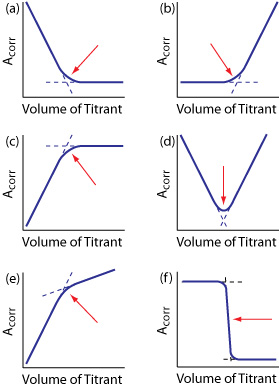
If at least one species in a complexation titration absorbs electromagnetic radiation, we can identify the end point by monitoring the titrand’s absorbance at a carefully selected wavelength. For example, we can […]
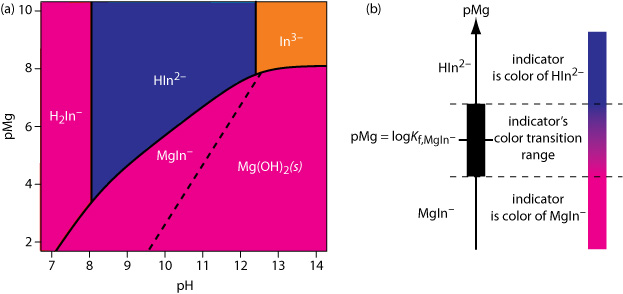
Most indicators for complexation titrations are organic dyes—known as metallochromic indicators—that form stable complexes with metal ions. The indicator, Inm–, is added to the titrand’s solution where it forms a stable complex […]
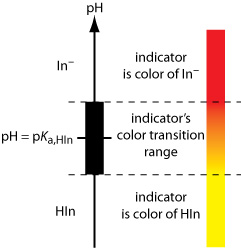
The illustration below shows the relationship between pH and an indicator’s color. The ladder diagram defines pH values where each of the indicator’s two forms the weak acid form, HIn, which in […]
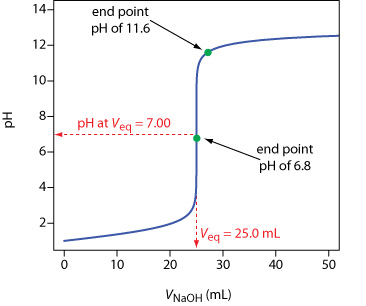
Typical acid–base titration curve showing how the titrand’s pH changes with the addition of titrant. The titrand is a 25.0 mL solution of 0.100 M HCl and the titrant is 0.100 M […]