Instrumentation for Flow Injection Analysis
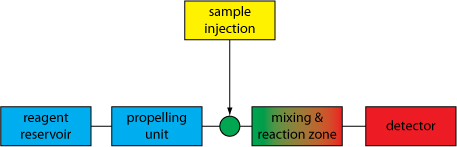
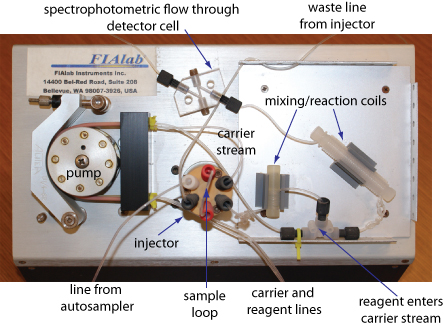
The basic components of a flow injection analyzer are shown below and include a pump for propelling the carrier stream and reagent streams, a means for injecting the sample into the carrier […]

Get a look at images, photos, videos, and animations that encompass many facets of teaching and learning about analytical chemistry.
The basic components of a flow injection analyzer are shown below and include a pump for propelling the carrier stream and reagent streams, a means for injecting the sample into the carrier […]
Flow injection analysis (FIA) was developed in the mid-1970s as a highly efficient technique for the automated analyses of samples. Unlike a centrifugal analyzer, in which the number of samples is limited […]
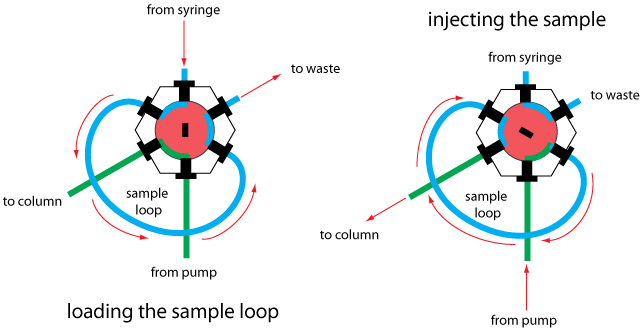
The operating pressure of an HPLC is sufficiently high that we cannot inject the sample into the mobile phase by inserting a syringe through a septum (as we can do in gas […]
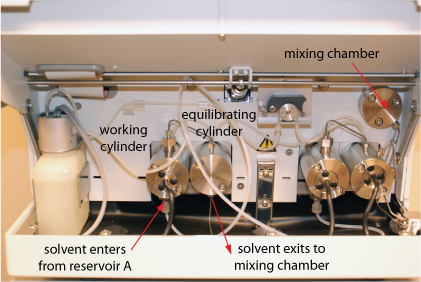
A typical HPLC includes between 1–4 reservoirs for mobile phase solvents. The mobile phase solvents are pulled from their reservoirs by the action of one or more pumps. Shown here is a close-up […]
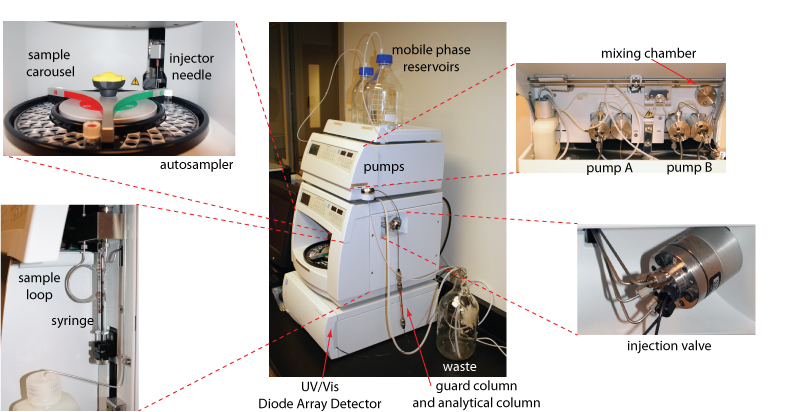
The photo below shows an example of a typical HPLC instrument with insets showing close-up views of the pumps that move the mobile phase through the system, and the plumbing used to inject […]
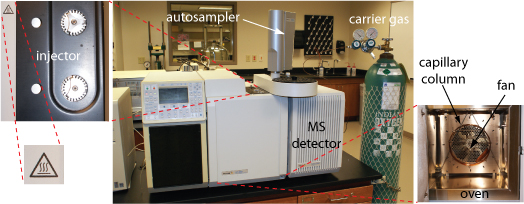
Photograph showing an example of a typical gas chromatograph with insets showing the heated injection ports—note the symbol indicating that it is hot—and the oven containing the column. This particular instrument is […]
A potentiostat is used to set and control the potential of a working electrode. A schematic diagram for a manual potentiostat is shown here where W is the working electrode, A is the auxiliary […]
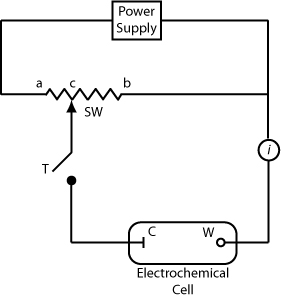
To measure the potential of an electrochemical cell under a condition of zero current we use a potentiometer. Shown here is a schematic diagram for a manual potentiometer, which consists of a […]
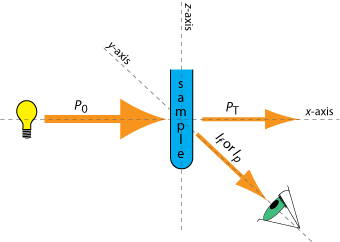
Turbidimetry and nephelometry are two techniques based on the elastic scattering of radiation by a suspension of colloidal particles: (a) in turbidimetry the detector is placed in line with the source and […]
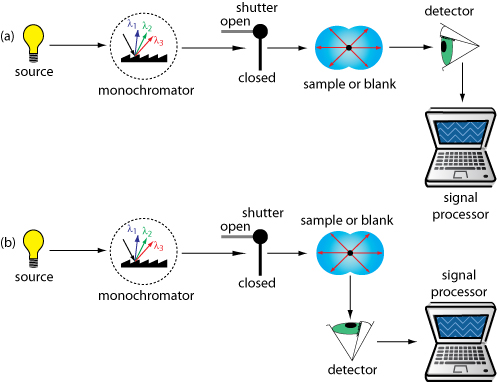
The basic instrumentation for monitoring fluorescence and phosphorescence—a source of radiation, a means of selecting a narrow band of radiation, and a detector—are the same as those for absorption spectroscopy. The unique […]
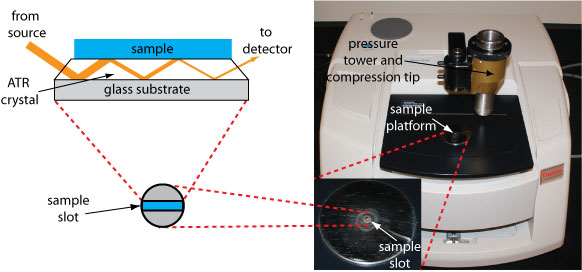
The illustration below shows an FT-IR spectrometer equipped with a diamond ATR sample cell. The inserts show a close-up photo of the sample platform, a sketch of the ATR’s sample slot, and […]
Several of the posts in the Analytical Image and Video Exchange include schematic diagrams of spectrophotometers. Gathered here are jpeg files for the various components used to create these schematic diagrams. source […]