Pulse Polarography
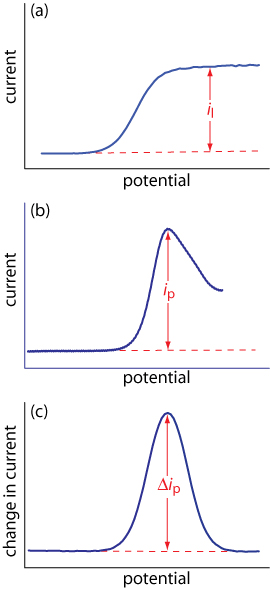
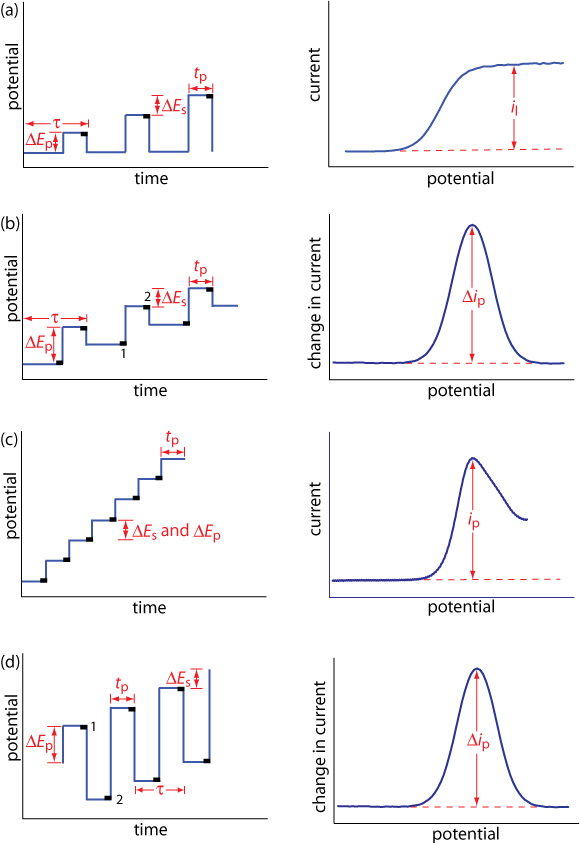
Normal polarography has been replaced by various forms of pulse polarography, several examples of which are shown here. Normal pulse polarography (a), for example, uses a series of potential pulses characterized by […]

Normal polarography has been replaced by various forms of pulse polarography, several examples of which are shown here. Normal pulse polarography (a), for example, uses a series of potential pulses characterized by […]
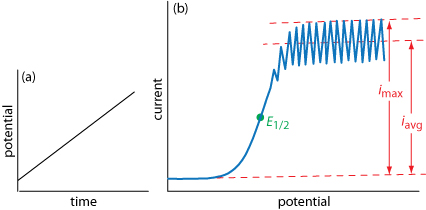
The first important voltammetric technique to be developed—polarography—uses the dropping mercury electrode as the working electrode. As shown here, the current flowing through the electrochemical cell is measured while applying a linear […]
In voltammetry we measure current as a function of the applied potential. The shape of a voltammogram is determined by several experimental factors, the most important of which are how we measure […]
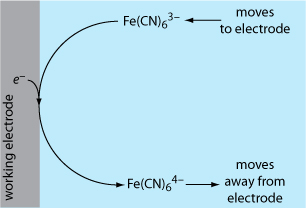
Let’s assume we have a solution that is 1.0 mM in Fe(CN)63– is 1.0 mM. The standard state potential for the reduction of Fe(CN)63– to Fe(CN)64– is +0.356 V. If we apply a potential of […]
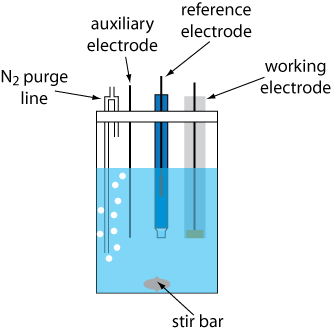
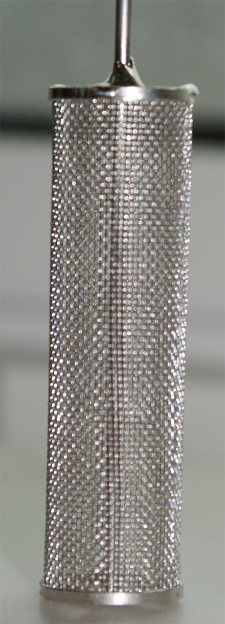
A typical arrangement for a voltammetric electrochemical cell is shown here. In addition to the working electrode, the reference electrode, and the auxiliary electrode, the cell also includes a N2-purge line for […]
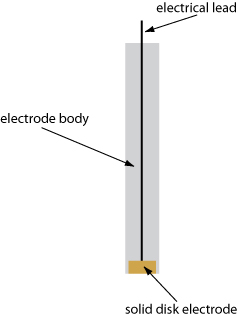
Schematic diagram showing a solid electrode. The electrode is fashioned into a disk and sealed in the end of an inert polymer support along with an electrical lead.
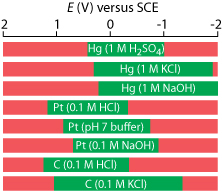
The approximate potential windows for mercury, platinum, and carbon (graphite) electrodes in acidic, neutral, and basic aqueous solvents are shown here. The useful potential windows are displayed in green; potentials in red […]
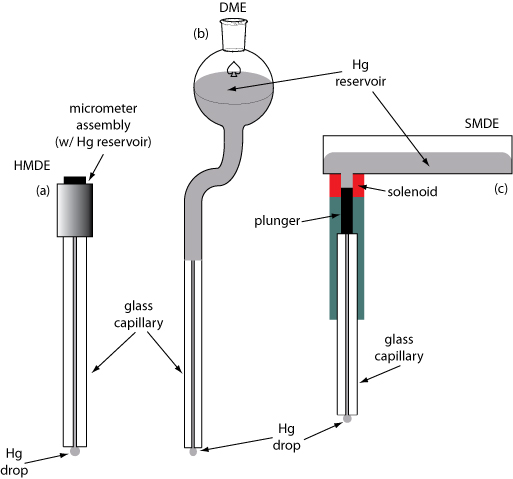
Three examples of mercury electrodes are illustrated here: (a) hanging mercury drop electrode, or HMDE; (b) dropping mercury electrode, or DME; and (c) static mercury drop electrode, or SMDE. In the hanging […]
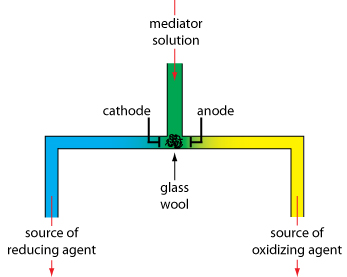
Shown here is one example of a device for the external generation of oxidizing agents and reducing agents for controlled-current coulometry. A solution containing the mediator flows into a small-volume electrochemical cell. […]
A second approach to coulometry is to use a constant current in place of a constant potential, which produces the current–time profile shown here. Controlled-current coulometry has two advantages over controlled-potential coulometry. […]
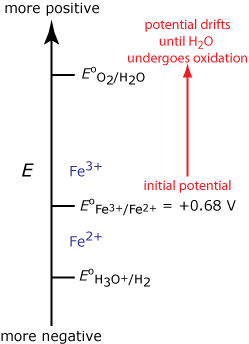
Coulometry is based on an exhaustive electrolysis of the analyte. By exhaustive we mean that the analyte is completely oxidized or reduced at the working electrode or that it reacts completely with […]
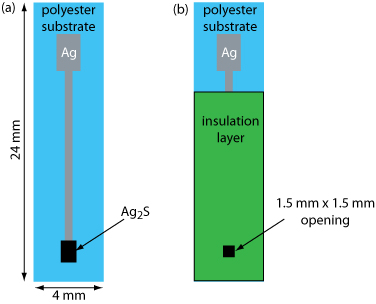
Schematic diagram of a disposable ion-selective electrode created by screen-printing. In (a) a thin film of conducting silver is printed on a polyester substrate and a film of Ag2S overlaid near the […]