Showing 49–60 of 193 posts

Chromatographic Resolution

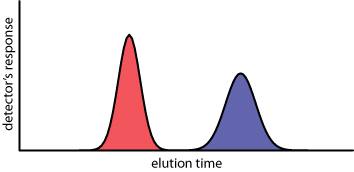
The goal of chromatography is to separate a mixture into a series of chromatographic peaks, each representing a single component of the mixture. The resolution between two chromatographic peaks, RAB, is a […]

Column Chromatography

The most common method for bringing the stationary phase and the mobile phases into contact is to hold the stationary phase within a column and to pass the mobile phase through the […]

Electrophoretic Separation

In chromatography, a separation occurs because there is a difference in the equilibrium partitioning of solutes between the mobile phase and the stationary phase. Equilibrium partitioning, however, is not the only basis […]

Chromatographic Separations

As illustrated below, in chromatography we pass a sample-free phase, which we call the mobile phase, over a second sample-free stationary phase that remains fixed in space. We inject or place the […]

Liquid-Liquid Extractions

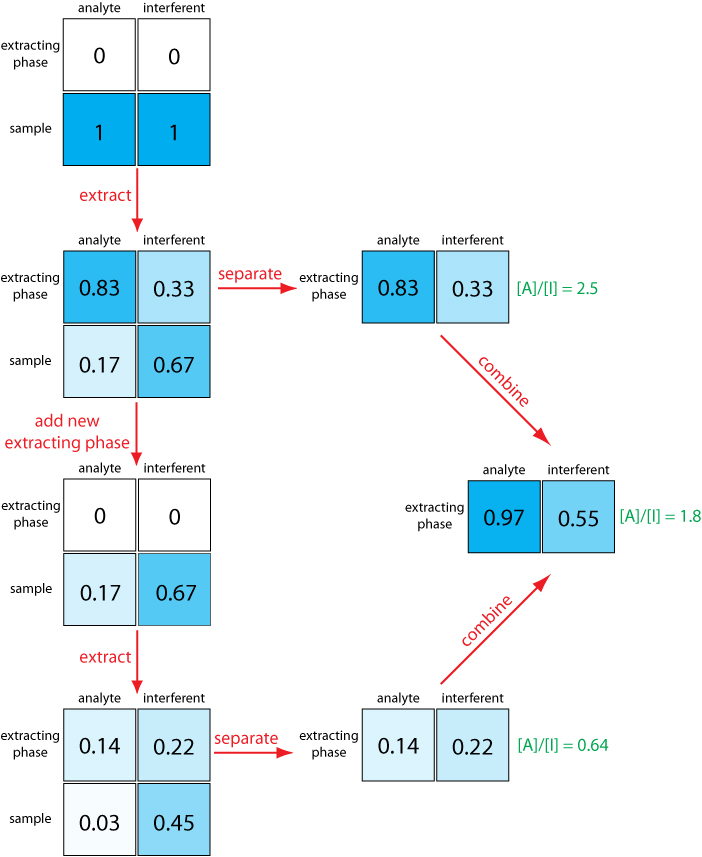
Shown here is an illustration outlining the progress of a traditional liquid–liquid extraction (LLE) using two identical extractions of a single sample with fresh portions of the extractant. The numbers give the […]

Cyclic Voltammetry

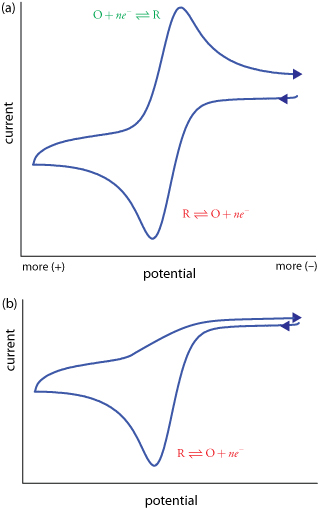
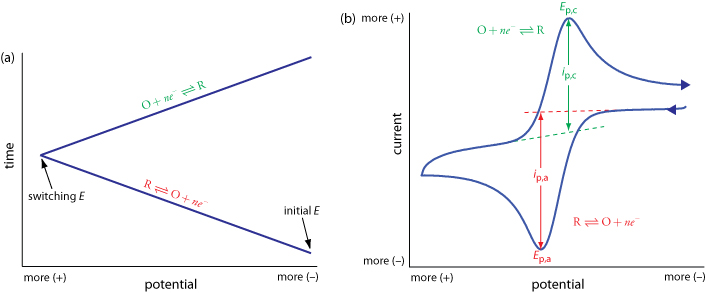
In cyclic voltammetry (CV) we scan the potential in both the cathodic and anodic directions. The illustration below shows a typical potential-excitation signal (a) in which we first scan the potential to […]

Anodic Stripping Voltammetry

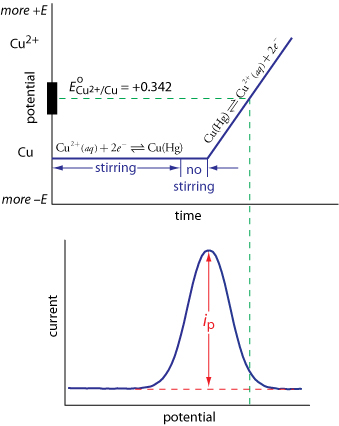
As illustrated here, anodic stripping voltammetry (ASV) consists of two steps. The first step is a controlled potential electrolysis in which we hold the working electrode—usually a hanging mercury drop or a […]