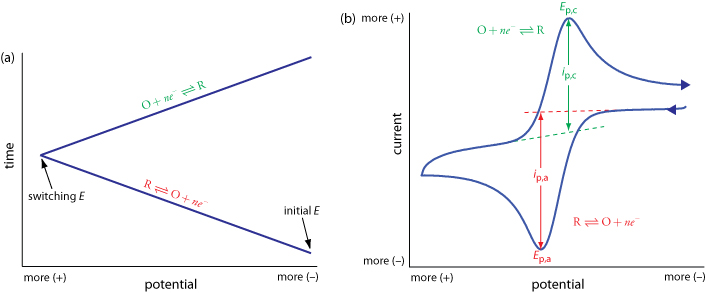
In cyclic voltammetry (CV) we scan the potential in both the cathodic and anodic directions. The illustration below shows a typical potential-excitation signal (a) in which we first scan the potential to more positive values, oxidizing R to O, and then reverse directions and scan to more negative potentials, reducing O to R.

Because we carry out cyclic voltammetry in an unstirred solution, the resulting cyclic voltammogram (b) has peak currents instead of limiting currents. The voltammogram has separate peaks for the oxidation reaction and the reduction reaction, each characterized by a peak potential and a peak current.