Singlet and Triplet States
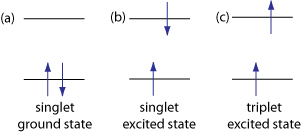
Photoluminescence is divided into two categories: fluorescence and phosphorescence. A pair of electrons occupying the same electronic ground state have opposite spins and are said to be in a singlet spin state; […]

Photoluminescence is divided into two categories: fluorescence and phosphorescence. A pair of electrons occupying the same electronic ground state have opposite spins and are said to be in a singlet spin state; […]
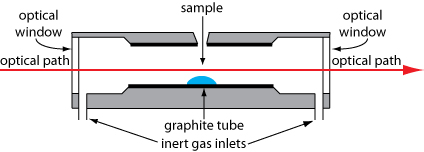
A typical electrothermal atomizer, also known as a graphite furnace, consists of a cylindrical graphite tube approximately 1–3 cm in length and 3–8 mm in diameter. As shown here, the graphite tube […]
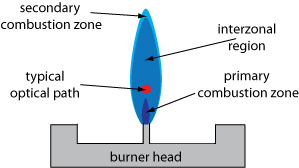
The illustration below shows a cross-section through a typical flame looking down the burner’s slot along the source radiation’s optical path. The primary combustion zone is usually rich in gas combustion products that […]
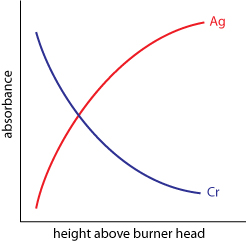
Where within the flame one measures absorbance is critical as two competing processes affect the concentration of free atoms in the flame. The more time the analyte spends in the flame the […]
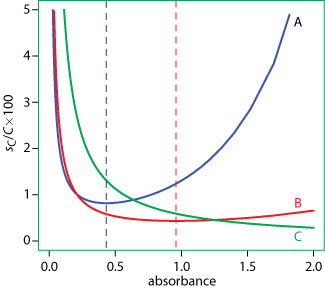
As shown here, the relative uncertainty in determining absorbance (and thus in determining concentration) is greater at very high and very low absorbances (that is, when very little or almost all of […]
In absorption spectroscopy, precision is limited by indeterminate errors—primarily instrumental noise—introduced when measuring absorbance. Precision is generally worse for low absorbances where P0≈ PT, and for high absorbances when PT approaches 0. […]
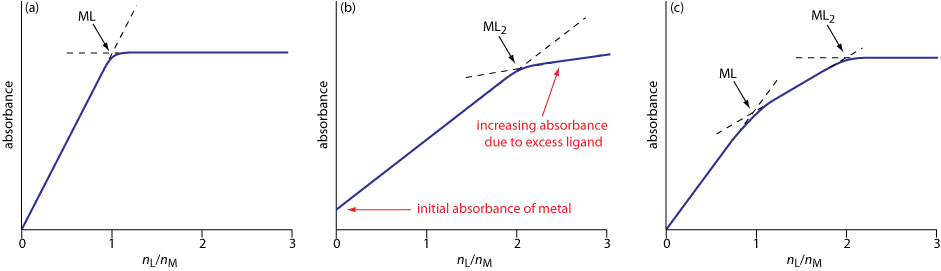
An alternative to the method of continuous variations for determining the stoichiometry of metal-ligand complexes is the mole-ratio method in which the amount of one reactant, usually the moles of metal, is held […]
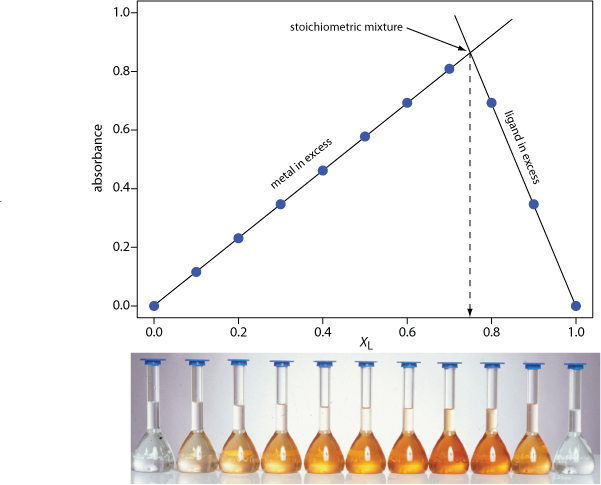
The method of continuous variations, also called Job’s method, is used to determine the stoichiometry of a metal-ligand complex. In this method we prepare a series of solutions such that the total […]
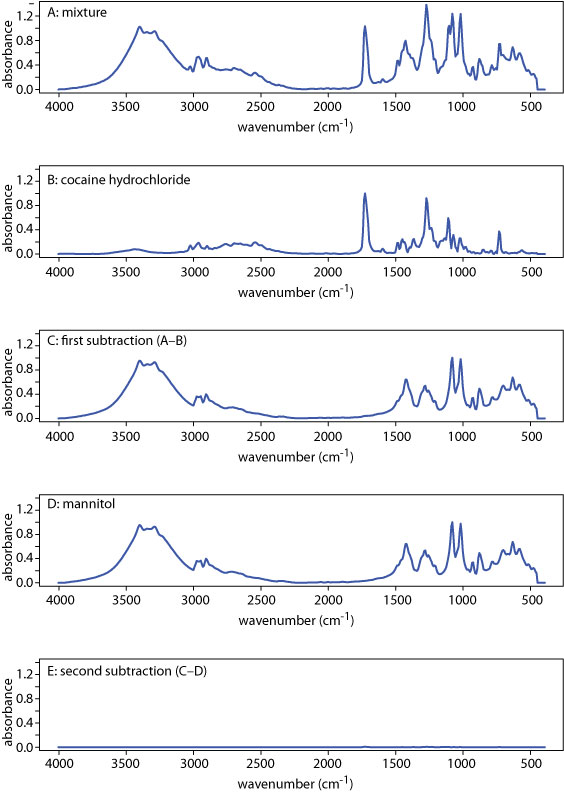
With the availability of computerized data acquisition and storage it is possible to build digital libraries of standard reference spectra. The identity of an a unknown compound can often be determined by […]
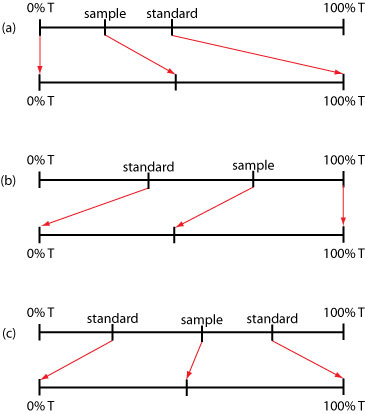
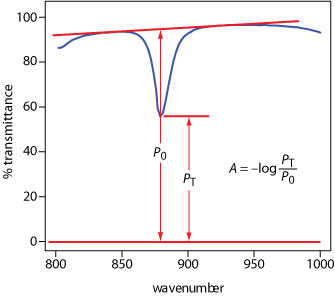
A quantitative analysis based on the absorption of infrared radiation, although important, is less frequently encountered than those for UV/Vis absorption. One reason is the difficulty in establishing a 100% T (A […]
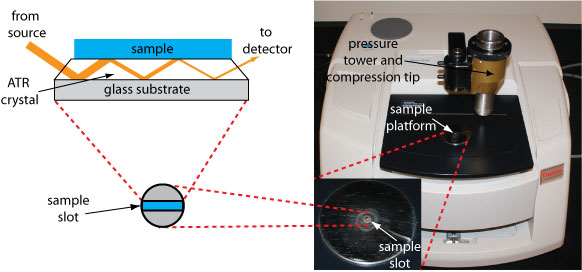
The illustration below shows an FT-IR spectrometer equipped with a diamond ATR sample cell. The inserts show a close-up photo of the sample platform, a sketch of the ATR’s sample slot, and […]
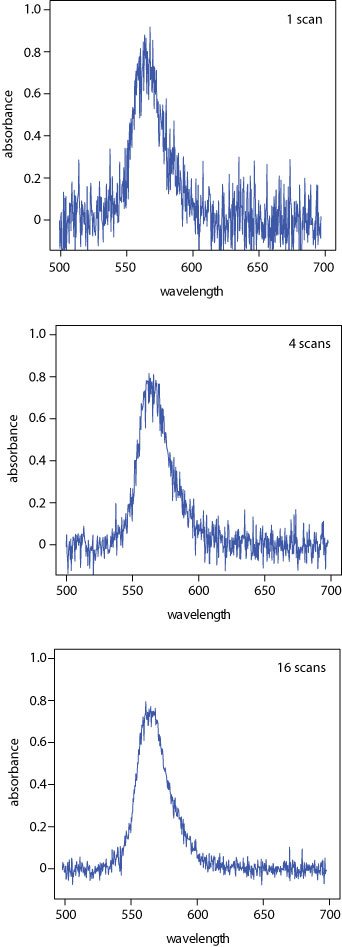
Examples showing the effect of signal averaging on a spectrum’s signal-to-noise ratio. From top to bottom: spectrum for a single scan; average spectrum after four scans; and average spectrum after adding 16 […]