
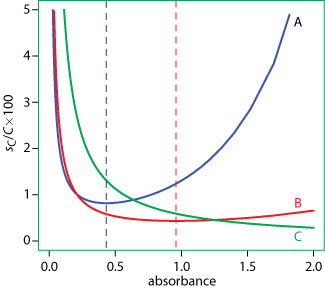
In absorption spectroscopy, precision is limited by indeterminate errors—primarily instrumental noise—introduced when measuring absorbance. Precision is generally worse for low absorbances where P0≈ PT, and for high absorbances when PT approaches 0. We might expect, therefore, that precision will vary with transmittance. The illustration below shows the percent relative uncertainty as a function of absorbance for three categories of indeterminate error: (A) uncertainty in reading the percent transmittance from the spectrometer’s scale and from thermal noise; (B) noise in photomultiplier and photodiode detectors; and (C) fluctuations in source intensity and variations in pathlength due to positioning of sample cell within the spectrometer. The dashed lines correspond to the minimum uncertainty for curve A (absorbance of 0.4343) and for curve B (absorbance of 0.963).
Uncertainty in Measurement of Absorbance


About the Author

David Harvey
David T. Harvey is a Professor Emeritus of Chemistry and Biochemistry at DePauw University in Greencastle, Indiana, where he has been a dedicated faculty member since 1986. Over his nearly four-decade career, Dr…
View contributions