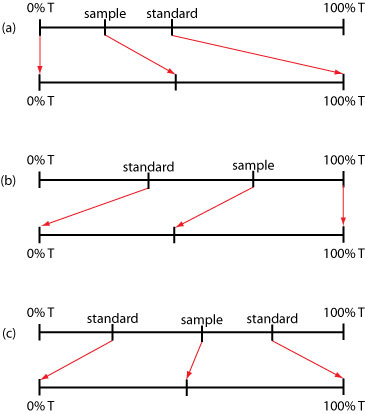
As shown here, the relative uncertainty in determining absorbance (and thus in determining concentration) is greater at very high and very low absorbances (that is, when very little or almost all of the source radiation reaches the detector. One way to improve the precision of such measurements is to redefine 100% T and 0% T, as shown here.

Normally 100% T is established using a blank and 0% T is established while preventing the source’s radiation from reaching the detector. If the absorbance is too high, precision can be improved by resetting 100% T using a standard solution of the analyte whose concentration is less than that of the sample, as shown in (a). For a sample whose absorbance is too low, precision can be improved by redefining 0% T using a standard solution of the analyte whose concentration is greater than that of the analyte, as shown in (b). In this case a calibration curve is required because a linear relationship between absorbance and concentration no longer exists. Precision can be increased further by combining these two methods, as shown in (c). Again, a calibration curve is necessary since the relationship between absorbance and concentration is no longer linear.