
A series of collaborative learning activities and accompanying text that develop chemical equilibrium, including acid-base chemistry, formation of water-soluble complexes, and solubility are provided. These activities are intended to be done in […]
a. Acid-base titrations
Students calculate the pH during the titration of a weak base. A text to accompany the worksheet is also provided.
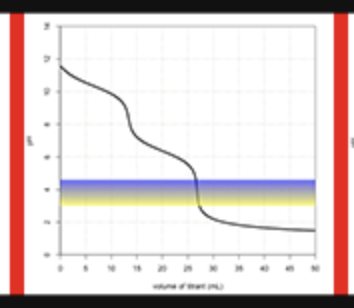
Introduction This learning module introduces students to acid-base titrimetry at a level suitable for an introductory course in analytical chemistry. The module assumes students are comfortable with stoichiometric calculations, particularly as they […]
Students explore titrations of weak acids and based using a titration simulator.
Students will learn to:
List and describe the factors/parameters that affect the shape of acid-base titration curves
Predict and explain why the change occurs when each of these factors/parameters is adjusted
Calculate the pH of solution and articulate its correlation to any point on the titration curve
Identify the different features on a diprotic acid titration curve
Students use an acid-base titration simulator to explore the effect of different variables.
Students will learn to: Determine the pH at any point throughout an acid-base titration including the titration of:
A strong acid with a strong base
A strong base with a strong acid
A weak acid with a strong base
A weak base with a strong acid
Describe the general nature of the solution in terms of how to calculate pH for the following regions of an acid-base titration:
Region I: before any titrant added
Region II: partway to the equivalence point
Region III: at the equivalence point
Region IV: past the equivalence point
Compare how concentration and strength of an acid or base changes the appearance of a titration curve.
Students examine the titration of monoprotic and polyprotic systems when completing this activity.
Students examine the titration of a weak acid when completing this activity.
Students learn to:
Use basic output from an analytical tool (buret) to calibrate that tool.
Use data to perform error analysis (identify the presence of random and/or systematic errors).
Standardize a sodium hydroxide (NaOH) solution using titration of potassium hydrogen phthalate (KHP) using a calibrated buret.
Report the determined concentration of the standardized NaOH solution.
Communicate (oral and written) scientific concepts related to calibration and standardization.

Introduction This module provides a real world context for introducing fundamental quantitative techniques (pH, Ion Selective Electrodes, Ion chromatography, and Titrimery) used in chemical analysis of water samples. Using active learning pedagogy, […]
Calculate analyte concentrations given experimental data from a back titration