
Students explore basic aspects of chromatographic separations including concepts such as number of theoretical plates, separation factor, retention factor and resolution. There is an associated text that explains the answers to the questions on the worksheet.
Active Learning Resources
Browse resources, explore categories, and discover materials contributed to the ASDL library.
In this activity, students explore basic concepts of electrochemical cells.
Students explore basic concepts of electrochemistry include electrochemical potential, the Nernst equation and electrochemical cells.
A lab activity involving the comparison of two spectrophotometric methods for the analysis of phosphate. Kyle Cissell, San Francisco State University (kacissel@sfsu.edu)
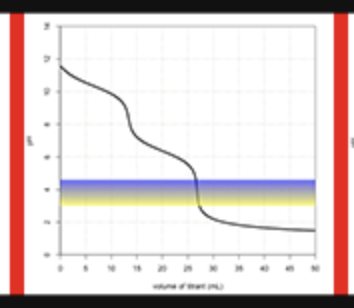
Introduction This learning module introduces students to acid-base titrimetry at a level suitable for an introductory course in analytical chemistry. The module assumes students are comfortable with stoichiometric calculations, particularly as they […]
Students explore titrations of weak acids and based using a titration simulator.
Students explore various aspects of solubility when completing this activity.
Students will learn to:
Calculate the pH of a solution containing strong and/or weak acids and/or bases.
Assess the reasonableness of a calculated pH of an acid/base solution.
Students will learn to:
List and describe the factors/parameters that affect the shape of acid-base titration curves
Predict and explain why the change occurs when each of these factors/parameters is adjusted
Calculate the pH of solution and articulate its correlation to any point on the titration curve
Identify the different features on a diprotic acid titration curve
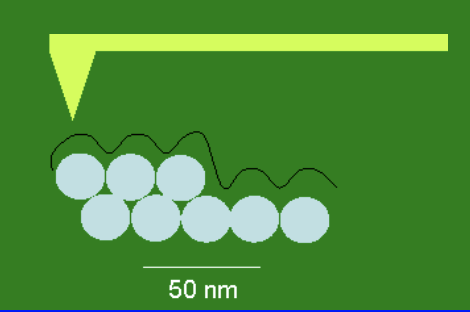
This module provides an introduction to Scanning Probe Microscopy (SPM). SPM is a family of microscopy techniques where a sharp probe (2-10 nm) is scanned across a surface and probe-sample interactions are monitored. SPM is […]
Basic electrochemical concepts including electrochemical cells are covered in this activity.
After completing the lab activity, students will be able to: Design an effective sampling strategy of solids by considering the necessary aspects of matrix and analyte (e.g. population vs. sample, phase of […]