Introduction A series of collaborative learning activities and accompanying text that develop the concept of concentration calibration, utilizing the external standard, internal standard, and standard addition methods. The module is based primarily […]
Active Learning Resources
Browse resources, explore categories, and discover materials contributed to the ASDL library.
After completing this activity, students will be able to: describe the relationship between the peak height in the mass spectrum and the natural abundance of isotopes differentiate between average mass, isotopic mass […]
Students explore Beer’s law and calculations that arise from applying Beer’s law.
Students examine the titration of monoprotic and polyprotic systems when completing this activity.
Students will learn:
Write the neutralization reaction between an acid and base.
Determine if a neutralization reaction goes to completion.
Calculate the equivalence point of a titration.
Use stoichiometry to determine the dominate species present after a neutralization reaction.
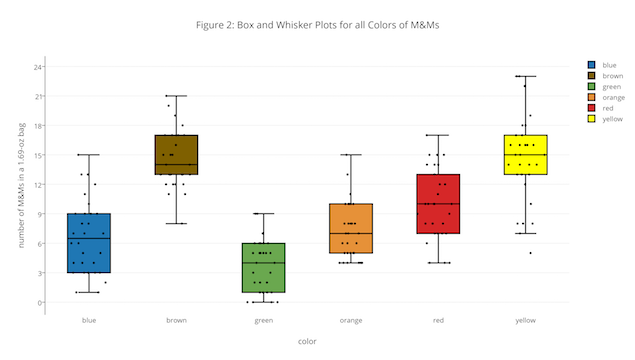
Introduction This module introduces students to ways of thinking about and working with data using, as a case study, the analysis of 1.69-oz packages of plain M&Ms. The module is divided into […]
Students examine the titration of a weak acid when completing this activity.
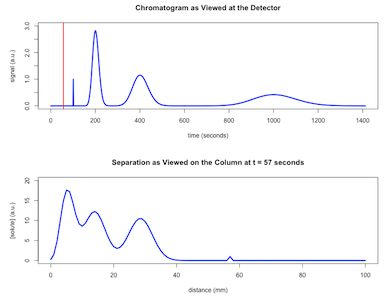
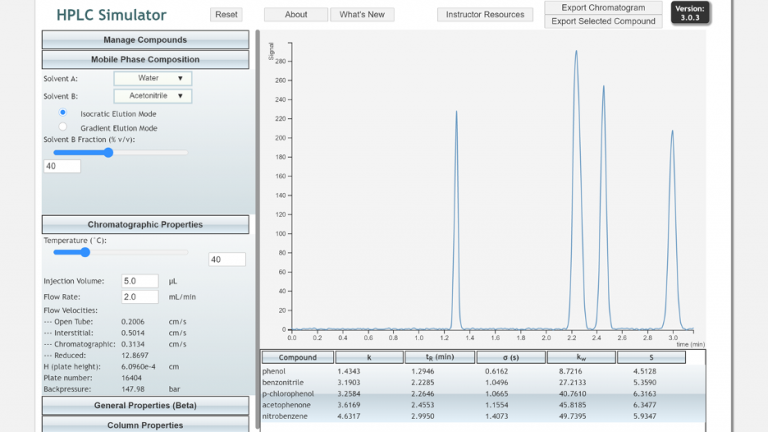
Introduction This learning module provides an interactive introduction to chromatography with an emphasis on understanding basic chromatographic terms and measurements, and on understanding the factors that affect the quality of a separation. […]
Students learn to:
Use basic output from an analytical tool (buret) to calibrate that tool.
Use data to perform error analysis (identify the presence of random and/or systematic errors).
Standardize a sodium hydroxide (NaOH) solution using titration of potassium hydrogen phthalate (KHP) using a calibrated buret.
Report the determined concentration of the standardized NaOH solution.
Communicate (oral and written) scientific concepts related to calibration and standardization.
Students will learn to:
Calculate mean and standard deviation from given sample data.
Apply Grubbs test to given sample data for the identification of outliers.
Given an experimental framework, identify and explain the types of calibration methods (curves, addition, and internal standard) used.
Differentiate between calibration methods needed for the accurate measurement of an analyte in several different matrices.
Calculate and analyze FOM for calibration methods
Students will learn to:
Predict and explain the elution order of analytes.
Explain the effects of temperature programs and flow rate on resolution at the macroscopic and molecular level.
Explain the effects of flow rate.
Select separation conditions for a given set of molecules.