Solid Electrodes
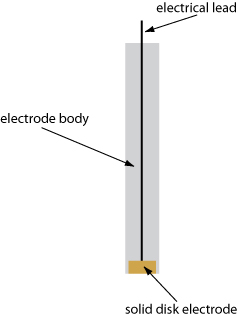
Schematic diagram showing a solid electrode. The electrode is fashioned into a disk and sealed in the end of an inert polymer support along with an electrical lead.

Explore resources, experiments, and teaching materials shared by the analytical sciences community.
Schematic diagram showing a solid electrode. The electrode is fashioned into a disk and sealed in the end of an inert polymer support along with an electrical lead.
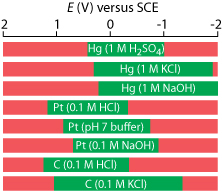
The approximate potential windows for mercury, platinum, and carbon (graphite) electrodes in acidic, neutral, and basic aqueous solvents are shown here. The useful potential windows are displayed in green; potentials in red […]
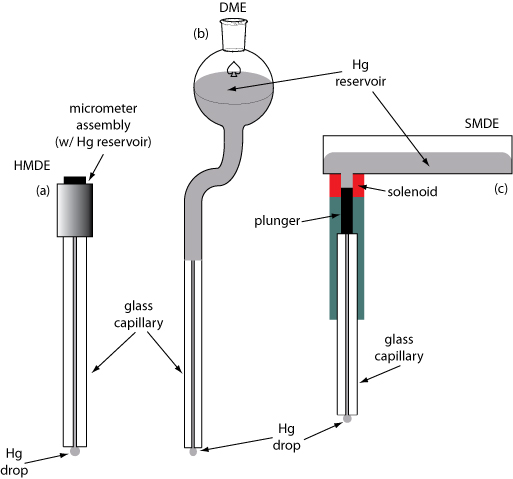
Three examples of mercury electrodes are illustrated here: (a) hanging mercury drop electrode, or HMDE; (b) dropping mercury electrode, or DME; and (c) static mercury drop electrode, or SMDE. In the hanging […]
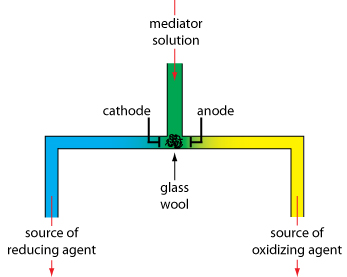
Shown here is one example of a device for the external generation of oxidizing agents and reducing agents for controlled-current coulometry. A solution containing the mediator flows into a small-volume electrochemical cell. […]
A second approach to coulometry is to use a constant current in place of a constant potential, which produces the current–time profile shown here. Controlled-current coulometry has two advantages over controlled-potential coulometry. […]
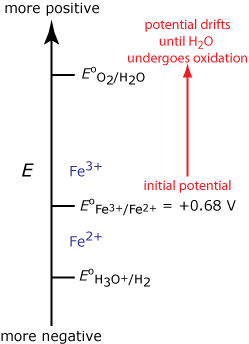
Coulometry is based on an exhaustive electrolysis of the analyte. By exhaustive we mean that the analyte is completely oxidized or reduced at the working electrode or that it reacts completely with […]
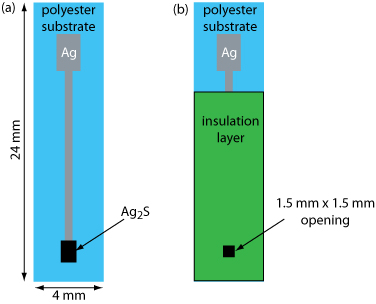
Schematic diagram of a disposable ion-selective electrode created by screen-printing. In (a) a thin film of conducting silver is printed on a polyester substrate and a film of Ag2S overlaid near the […]
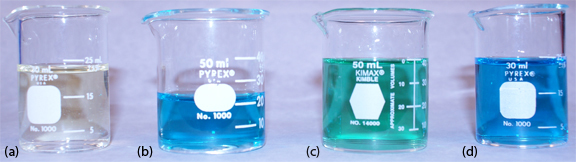
The photo below provides a demonstration of the difference between activity and concentration using the indicator methyl green. The indicator is yellow in its acid form (beaker a: 1.0 M HCl) and […]
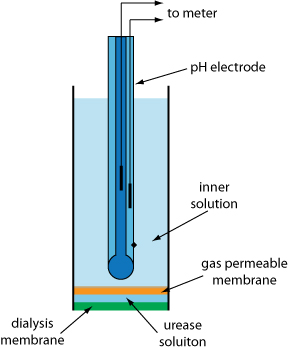
A gas-sensing electrode can be modified to create a potentiometric electrode that respond to a biochemically important species, such as enzymes. One example of an enzyme electrode is the urea electrode, which is […]
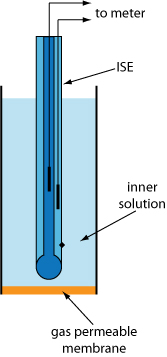
A number of membrane electrodes respond to the concentration of a dissolved gas. The basic design of a gas-sensing electrode consists of a thin membrane that separates the sample from an inner […]
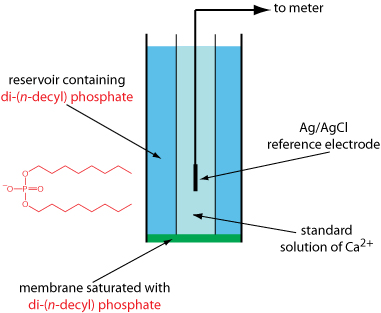
Another class of ion-selective electrodes uses a hydrophobic membrane containing a liquid organic complexing agent that reacts selectively with the analyte. Three types of organic complexing agents have been used: cation exchangers, […]
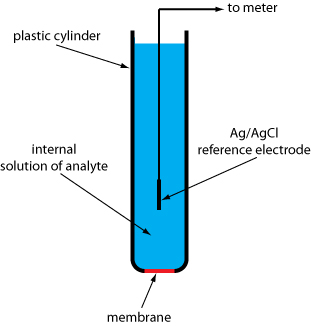
Schematic diagram of a solid-state electrode, the membrane for which is either a polycrystalline inorganic salt or a single crystal of an inorganic salt. We can fashion a polycrystalline solid-state ion-selective electrode […]