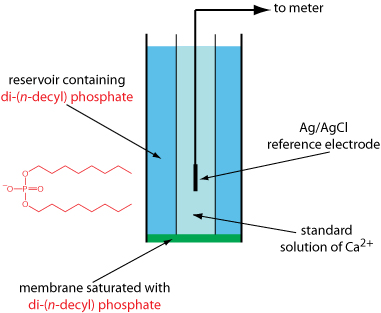
Another class of ion-selective electrodes uses a hydrophobic membrane containing a liquid organic complexing agent that reacts selectively with the analyte. Three types of organic complexing agents have been used: cation exchangers, anion exchangers, and neutral ionophores.
One example of a liquid-based ion-selective electrode is that for Ca2+, which uses a porous plastic membrane saturated with the cation exchanger di-(n-decyl) phosphate. As shown here, the membrane is placed at the end of a non-conducting cylindrical tube, and is in contact with two reservoirs. The outer reservoir contains di-(n-decyl) phosphate (shown in red) in di-n-octylphenylphosphonate, which soaks into the porous membrane. The inner reservoir contains a standard aqueous solution of Ca2+ and a Ag/AgCl reference electrode. Calcium ion-selective electrodes are also available in which the di-(n-decyl) phosphate is immobilized in a polyvinyl chloride (PVC) membrane, eliminating the need for the outer reservoir containing di-(n-decyl) phosphate.