
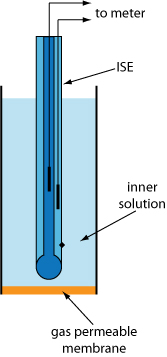
A number of membrane electrodes respond to the concentration of a dissolved gas. The basic design of a gas-sensing electrode consists of a thin membrane that separates the sample from an inner solution containing an ion-selective electrode. The membrane is permeable to the gaseous analyte, but impermeable to nonvolatile components in the sample’s matrix. The gaseous analyte passes through the membrane where it reacts with the inner solution, producing a species whose concentration is monitored by the ion-selective electrode. For example, in a CO2 electrode, shown here, CO2 diffuses across the membrane where it reacts in the inner solution to produce H3O+. The change in the activity of H3O+ in the inner solution is monitored with a pH electrode, and is proportional to the concentration of CO2 in the sample.
Gas-Sensing Membrane Electrode


About the Author

David Harvey
David T. Harvey is a Professor Emeritus of Chemistry and Biochemistry at DePauw University in Greencastle, Indiana, where he has been a dedicated faculty member since 1986. Over his nearly four-decade career, Dr…
View contributions