pH Electrode
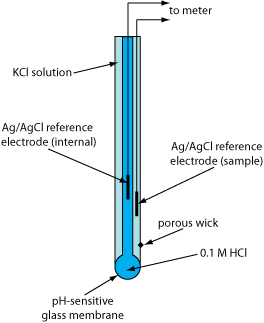
Schematic diagram showing a combination glass electrode for measuring pH. The indicator electrode consists of a pH-sensitive glass membrane and an internal Ag/AgCl reference electrode in a solution of 0.1 M HCl. […]

Explore resources, experiments, and teaching materials shared by the analytical sciences community.
Schematic diagram showing a combination glass electrode for measuring pH. The indicator electrode consists of a pH-sensitive glass membrane and an internal Ag/AgCl reference electrode in a solution of 0.1 M HCl. […]
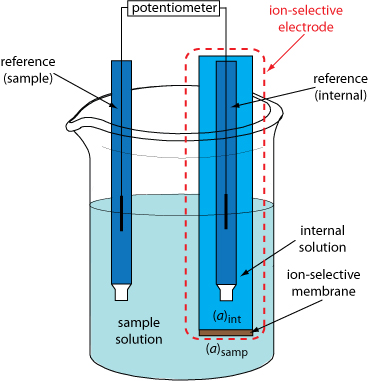
Shown here is a schematic diagram of a typical potentiometric cell that includes a membrane electrode (in this case, an ion-selective membrane). The membrane separates the sample solution, which contains the analyte […]
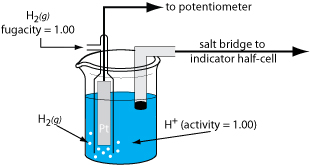
In a potentiometric electrochemical cell one half-cell provides a known reference potential and the potential of the other half-cell indicates the analyte’s concentration. The ideal reference electrode provides a stable, known potential so […]
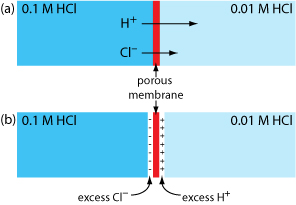
A junction potential develops at the interface between two ionic solution if there difference in the concentration and mobility of the ions. Consider, for example, a porous membrane separating solutions of 0.1 […]
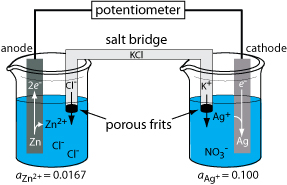
Shown here is the schematic diagram of a typical potentiometric electrochemical cell. The electrochemical cell consists of two half-cells, each consisting of an electrode immersed in a solution of ions whose activities […]
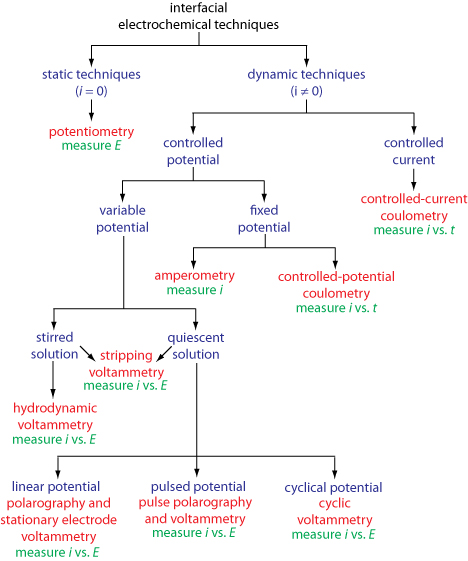
Shown here is a family tree that highlights a number of interfacial electrochemical techniques. The specific techniques are shown in red, the experimental conditions are shown in blue, and the analytical signals […]
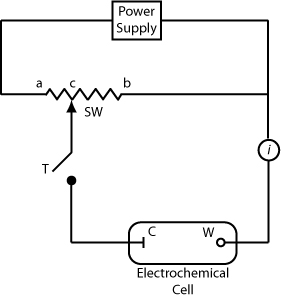
A potentiostat is used to set and control the potential of a working electrode. A schematic diagram for a manual potentiostat is shown here where W is the working electrode, A is the auxiliary […]
A galvanostat is used to control the current flowing through an electrochemical cell. A schematic diagram of a constant-current galvanostat is shown here where A is the auxiliary electrode, W is the working […]
To measure the potential of an electrochemical cell under a condition of zero current we use a potentiometer. Shown here is a schematic diagram for a manual potentiometer, which consists of a […]
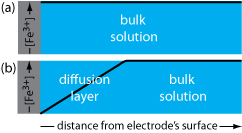
In electrochemistry, there is an important distinction between the concentration of a species at the electrode’s surface and its concentration at some distance from the electrode’s surface (in what we call the […]
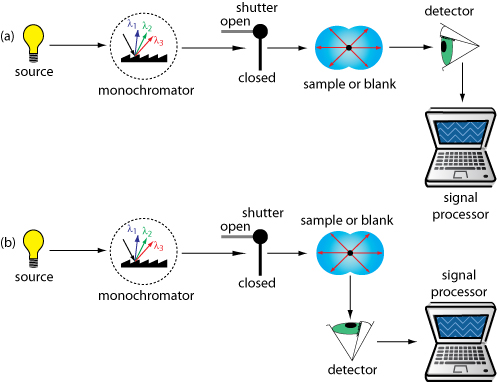
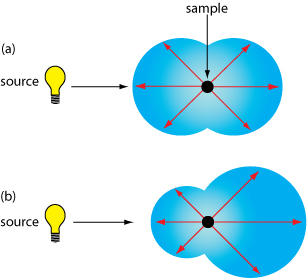
Turbidimetry and nephelometry are two techniques based on the elastic scattering of radiation by a suspension of colloidal particles: (a) in turbidimetry the detector is placed in line with the source and […]
Elastic scattering is divided into two types: Rayleigh, or small-particle scattering, and large-particle scattering. Rayleigh scattering occurs when the scattering particle’s largest dimension is less than 5% of the radiation’s wavelength. The […]