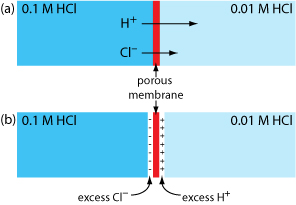
A junction potential develops at the interface between two ionic solution if there difference in the concentration and mobility of the ions. Consider, for example, a porous membrane separating solutions of 0.1 M HCl and 0.01 M HCl, as shown here.

Because the concentration of HCl on the membrane’s left side is greater than that on the right side of the membrane, H+ and Cl– diffuse in the direction of the arrows. The mobility of H+, however, is greater than that for Cl–, as shown by the difference in the lengths of their respective arrows. Because of this difference in mobility, the solution on the right side of the membrane has an excess of H+ and a positive charge. Simultaneously, the solution on the membrane’s left side develops a negative charge because there is an excess concentration of Cl–. We call this difference in potential across the membrane a junction potential, which we represent as Ej.