
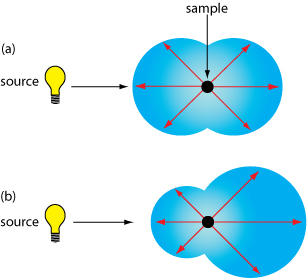
Elastic scattering is divided into two types: Rayleigh, or small-particle scattering, and large-particle scattering. Rayleigh scattering occurs when the scattering particle’s largest dimension is less than 5% of the radiation’s wavelength. The intensity of the scattered radiation is proportional to its frequency to the fourth power, ν4—accounting for the greater scattering of blue light than red light—and is symmetrically distributed, as shown in (a) below. For larger particles, scattering increases in the forward direction and decreases in the backwards direction as the result of constructive and destructive interferences, as shown in (b).
Elastic Scattering of Light From Particles


About the Author

David Harvey
David T. Harvey is a Professor Emeritus of Chemistry and Biochemistry at DePauw University in Greencastle, Indiana, where he has been a dedicated faculty member since 1986. Over his nearly four-decade career, Dr…
View contributions