
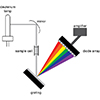
A series of collaborative learning activities and accompanying text that develop the areas of molecular and atomic spectroscopy is provided. Chapters on basics of spectrophotometry, ultraviolet/visible absorption, molecular fluorescence, infrared, Raman and […]
h. Atomic Spectroscopy
Students explore basic aspects of atomic spectroscopy including absorption and emission. Flame and graphite furnace AA are covered. ICP emission spectroscopy is covered. The importance of matrix effects is developed. There is an associated text that explains the answers to the questions on the worksheet.

Toxic trace metals are possible culprits for the ongoing deaths of large numbers of lesser flamingos at Lake Nakuru, Kenya. In this section we explore the possible role of heavy metals in these deaths and examine instrumental methods utilized to evaluate levels of copper, zinc, lead and chromium present in Lake Nakuru sediment and suspended solid samples. These methods include anodic stripping voltammetry (ASV), atomic spectroscopy, and x-ray fluorescence spectroscopy (XRF). Data sets are provided for each technique so that current levels can be calculated and compared to those contained in a report published in 1998.
[vc_row][vc_column icons_position=”left”][vc_column_text] Introduction This module provides a context for introducing fundamental techniques used in chemical analysis (spectrophotometry, atomic absorbance spectroscopy and ion selective electrodes) along with considerations about sampling and sample preservation. […]
Introduction These assignments are designed to be capstone activities at the end of units on figures of merit (such as sensitivity and LOD), acid-base equilibria, separations, spectroscopy, mass spectrometry, and electrochemistry. Each […]