
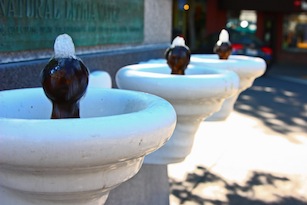
Introduction Can the most prevalent inorganic ions be determined in Lithia water using a representative cross-section of the analytical techniques (e.g. titrimetry, potentiometry, spectroscopy) covered in a typical quantitative analysis course? The […]
Active Learning Resources
Browse resources, explore categories, and discover materials contributed to the ASDL library.
Students work through the basics of the nitrogen rule as well its application to the EI and ESI mass spectra of cocaine. David Griffith, Willamette University (dgriffit@willamette.edu)
Students will learn to:
dentify interfering matrix components
Be familiar with different extraction processes
Understand the derivatization process for increasing sample volatility
Students explore a variety of calibration procedures when completing this activity.
Students learn to:
Calculate the standard deviation and confidence interval for a data set.
Describe the precision of a data set.
Describe the accuracy of a data set.
Estimate the sensitivity and linear dynamic range from a calibration curve.
Calculate the detection limit and limit of quantitation from a data set.

[vc_row][vc_column icons_position=”left”][vc_column_text] Introduction This module provides a context for introducing fundamental techniques used in chemical analysis (spectrophotometry, atomic absorbance spectroscopy and ion selective electrodes) along with considerations about sampling and sample preservation. […]
Students explore aspects of the Fourier transform process in an FT-ICR-MS instrument. David Griffith, Willamette University (dgriffit@willamette.edu)
Students will learn: Write the equilibrium expression and solubility product for a precipitation reaction.
Calculate the solubility of a sparingly soluble compound.
Predict the order of precipitation in a mixture.
Predict the extent of precipitation in a mixture.
Students learn to:
Identify different methods to calibrate instrumentation or analytical methodologies
Choose proper calibration method depending on sample characteristics or instrument.
Describe how standards and/or samples are prepared for each calibration method.
Calculate concentration from information obtained from each calibration method
Introduction This module provides a real world context for introducing fundamental quantitative techniques (pH, Ion Selective Electrodes, Ion chromatography, and Titrimery) used in chemical analysis of water samples. Using active learning pedagogy, […]
Students explore the influence of ionic strength on solubility when completing this activity.
Students explore a variety of calibration methods when completing this activity.