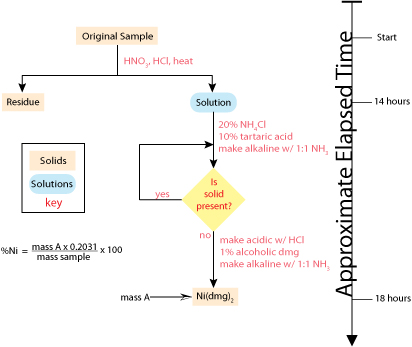
One distinction between analytical chemistry and chemical analysis is that analytical chemists work to improve and extend established analytical methods. For example, several factors complicate the quantitative analysis of nickel in ores, including nickel’s unequal distribution within the ore, the ore’s complex matrix of silicates and oxides, and the presence of other metals that may interfere with the analysis. For example, in the 1880’s, Fresenius developed the procedure for the analysis of Ni in ores outlined in the following flowchart

Note that the mass of nickel is not determined directly in this procedure; instead, Co and Ni are isolated and weighed (mass A), and then Co is isolated and weighed (mass B). The procedure also is lengthy, requiring approximately 44 hours to complete an analysis following the initial digestion of the sample.
As shown in the following flowchart the development, in 1905, of dimethylglyoxime (dmg), a reagent that selectively precipitates Ni2+ and Pd2+, allowed for a simpler analysis requiring fewer manipulations and less time—4 hours instead of 44 hours—following initial digestion of the sample.
 The routine application of these procedures is chemical analysis.