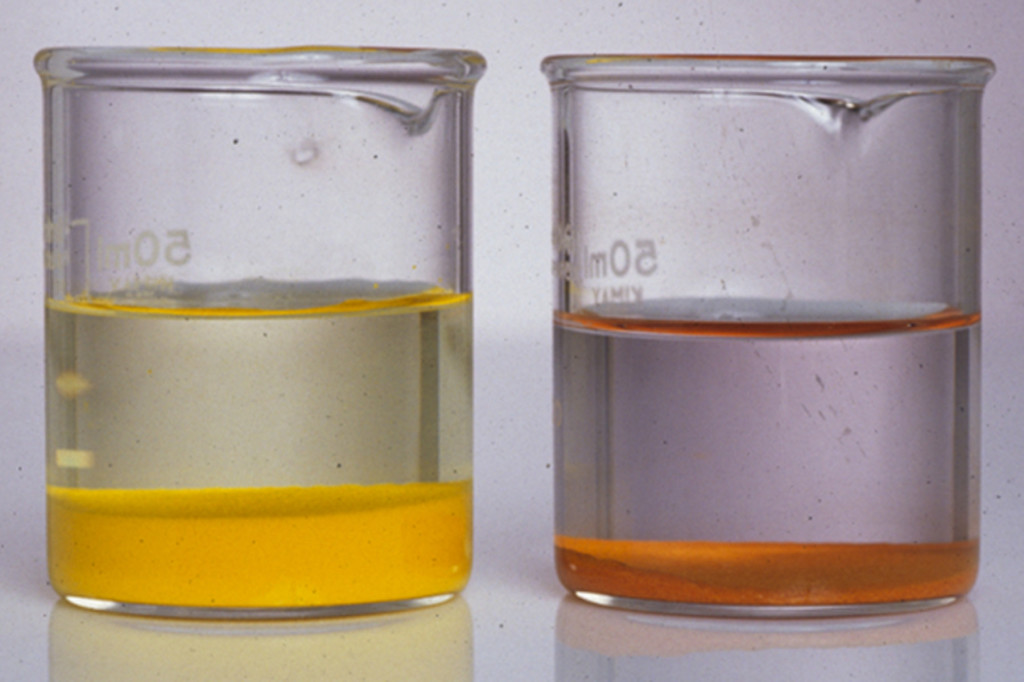
Two precipitates of PbCrO4 are shown in this photo. The precipitate in the beaker on the left was formed by pouring quickly a solution 0.1 M Pb(NO3)2 into a solution of 0.1 M K2CrO4. The precipitate forms rapidly and consists of very small particles. The precipitate in the beaker on the right was formed by heating a solution of 0.1 M Pb(NO3)2, 0.1 M Cr(NO3)3, and 0.1 M KBrO3. Under these conditions, the slow oxidation of Cr3+ to CrO42– results in a precipitate that forms slowly and consists of much larger particles. This latter process is called homogeneous precipitation, which generally results in a precipitate that is easier to isolate by filtration and that has fewer impurities.