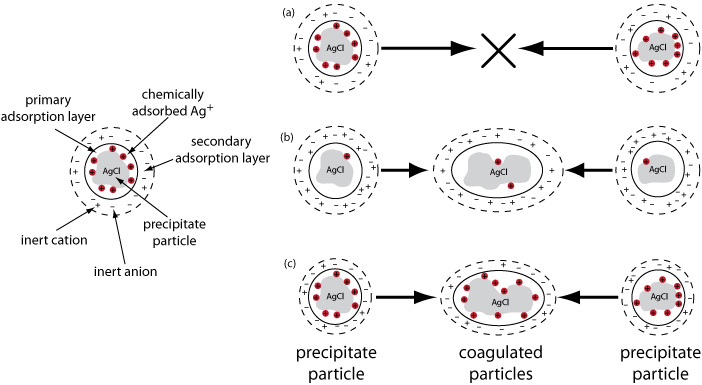
Two methods for coagulating a precipitate of AgCl are illustrated here: (a) because of electrostatic repulsion, coagulation will not take place if both particles are positively charged; (b) decreasing the charge within the primary adsorption layer, by adding additional NaCl, decreases the electrostatic repulsion, allowing the particles to coagulate; (c) adding additional inert ions decreases the thickness of the secondary adsorption layer, allowing the particles to approach each other more closely and to coagulate.