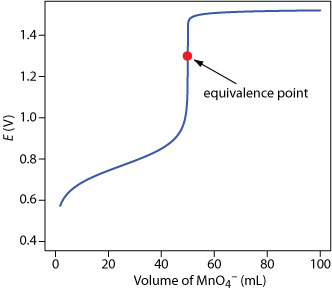
For an acid–base titration or a complexometric titration, the equivalence point is almost identical to the inflection point near the middle of the steeply rising part of the titration curve, which makes it relatively easy to locate the equivalence point (see here for an example from acid-base titrimetry). We call this a symmetric equivalence point. If the stoichiometry of a redox titration is symmetric—that is, one mole of titrant reacts with each mole of titrand—then the equivalence point is symmetric as well. If the titration reaction’s stoichiometry is not 1:1, then the equivalence point is closer to the top or to bottom of the titration curve’s sharp rise, as shown here for the titration of 50.0 mL of 0.100 M Fe2+ with 0.0200 M MnO4– at a fixed pH of 1 (using H2SO4). This asymmetric equivalence point is shown by the red dot.

The titration reaction in this case is
5Fe2+(aq) + MnO4–(aq) + 8H+(aq) ↔ 5F3+(aq) + Mn2+(aq) + 4H2O(l)