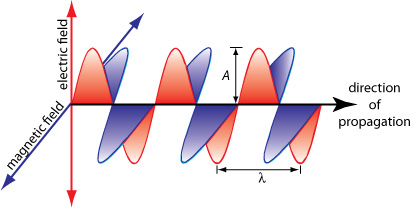
Illustration of plane-polarized electromagnetic radiation showing the oscillating electric field in red and the oscillating magnetic field in blue. The radiation’s amplitude, A, and its wavelength, λ, are shown. Normally, electromagnetic radiation is unpolarized, with oscillating electric and magnetic fields present in all possible planes perpendicular to the direction of propagation.

The wavelength (and frequency) of electromagnetic radiation vary over many orders of magnitude. For convenience, we divide electromagnetic radiation into different regions—the electromagnetic spectrum—based on the type of atomic or molecular transition that gives rise to the absorption or emission of photons (see illustration below). The boundaries between the regions of the electromagnetic spectrum are not rigid and overlap between spectral regions is possible. The colored inset shows the visible spectrum.

(This illustration is modified from a figure created by Philip Ronan and Gringer—the original file is located here—and released under a CC-BY-SA-3.0 copyright via Wikimedia Commons.)