
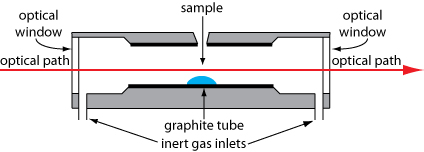
A typical electrothermal atomizer, also known as a graphite furnace, consists of a cylindrical graphite tube approximately 1–3 cm in length and 3–8 mm in diameter. As shown here, the graphite tube is housed in an sealed assembly with optically transparent windows at each end. A continuous stream of an inert gas is passed through the furnace, protecting the graphite tube from oxidation and removing the gaseous products produced during atomization. A power supply is used to pass a current through the graphite tube, resulting in resistive heating. Samples of between 5–50 μL are injected into the graphite tube through a small hole at the top of the tube.
Graphite Furnace


About the Author

David Harvey
David T. Harvey is a Professor Emeritus of Chemistry and Biochemistry at DePauw University in Greencastle, Indiana, where he has been a dedicated faculty member since 1986. Over his nearly four-decade career, Dr…
View contributions