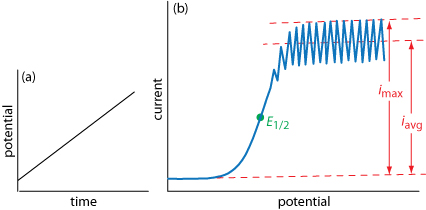
The first important voltammetric technique to be developed—polarography—uses the dropping mercury electrode as the working electrode. As shown here, the current flowing through the electrochemical cell is measured while applying a linear potential ramp.

Although polarography takes place in an unstirred solution, we obtain a limiting current instead of a peak current. When a Hg drop separates from the glass capillary and falls to the bottom of the electrochemical cell, it mixes the solution. Each new Hg drop, therefore, grows into a solution whose composition is identical to the bulk solution. The oscillations in the current are a result of the Hg drop’s growth, which leads to a time-dependent change in the area of the working electrode. The limiting current—which is also called the diffusion current—is measured using either the maximum current, imax, or from the average current, iavg.