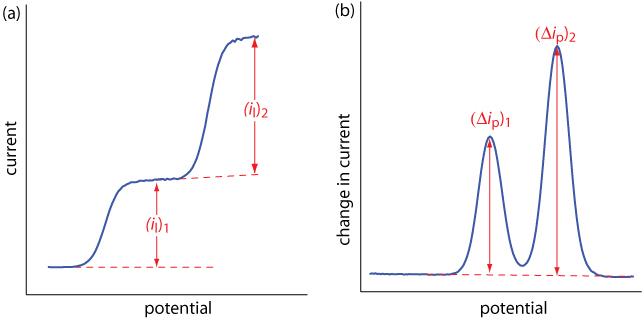
Voltammetry is a particularly attractive technique for the analysis of samples containing two or more analytes. Provided that the analytes behave independently, the voltammogram of a multicomponent mixture is a summation of each analyte’s individual voltammograms. As shown here, if the separation between the half-wave potentials or between the peak potentials is sufficient, we can independently determine each analyte as if it is the only analyte in the sample. The minimum separation between the half-wave potentials or peak potentials for two analytes depends on several factors, including the type of electrode and the potential-excitation signal: (a) for normal polarography the separation must be at least ±0.2–0.3 V; (b) for differential pulse voltammetry a minimum separation of ±0.04–0.05 V is needed.