
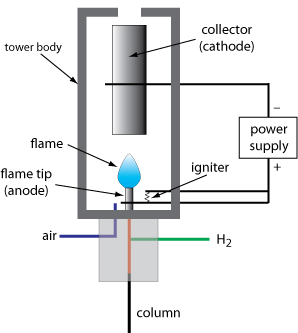
The schematic diagram below shows a flame ionization detector for gas chromatography. The eluent from the column mixes with H2 and is burned in the presence of excess air. Combustion of organic analytes produces a flame containing electrons and organic cations, presumably CHO+. Applying a potential of approximately 300 volts between the flame tip and the collector, generates a small current of roughly 10–9 to 10–12 amps. that, when amplified, provides a useful analytical signal proportional to the concentration of cations—and thus the concentration of analyte—in the flame.
Flame Ionization Detector


About the Author

David Harvey
David T. Harvey is a Professor Emeritus of Chemistry and Biochemistry at DePauw University in Greencastle, Indiana, where he has been a dedicated faculty member since 1986. Over his nearly four-decade career, Dr…
View contributions