
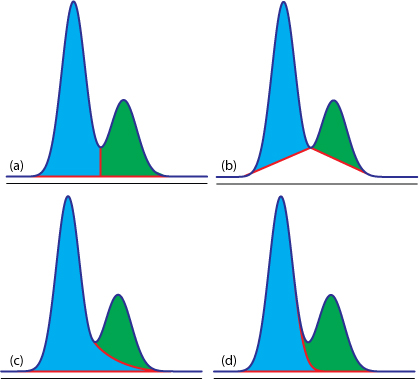
In a GC analysis the area under the peak is proportional to the amount of analyte injected onto the column. The peak’s area is determined by integration, which usually is handled by the instrument’s computer or by an electronic integrating recorder. If two peak are fully resolved, the determination of their respective areas is straightforward. Overlapping peaks, however, require a choice between one of several options for dividing up the area shared by the two peaks, four of which are outlined here: (a) the drop method; (b) the valley method; (c) the exponential skim method; and (d) the Gaussian skim method. Which method to use depends on the relative size of the two peaks and their resolution. In some cases, the use of peak heights provides more accurate results. Other methods for determining areas also are available.
Finding the Area for Overlapping Chromatographic Peaks


About the Author

David Harvey
David T. Harvey is a Professor Emeritus of Chemistry and Biochemistry at DePauw University in Greencastle, Indiana, where he has been a dedicated faculty member since 1986. Over his nearly four-decade career, Dr…
View contributions