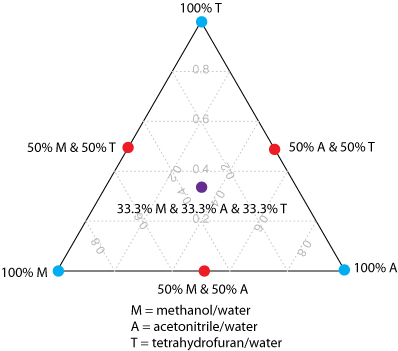
One strategy for finding the best mobile phase for an HPLC separation is to use the solvent triangle, which allows us to explore a broad range of mobile phases with just seven experiments. We begin by adjusting the amount of acetonitrile in a CH3CN/H2O mobile phase, producing the best possible separation within the desired analysis time. Next, we use the following table to estimate the composition of methanol/H2O and tetrahydrofuran/H2O mobile phases that will produce similar analysis times.

These three mobile phases (identified as 100% T, 100% M, and 100% A in the solvent triangle shown below), along with three 50:50 binary mobile phases and a 1/3:1/3:1/3 ternary mobile phases make up the seven experiments. By evaluating the chromatograms from these seven mobile phases, we may find that one or more provides an adequate separation, or identify a region within the solvent triangle where a separation if feasible.

The illustration below shows results for the reversed-phase separation of benzoic acid, terephthalic acid, p-aminobenzoic acid, and p-hydroxybenzoic acid on a nonpolar C18 column in which the maximum analysis time is set to 6 min. The areas in blue, green, and red show mobile phase compositions that do not provide baseline resolution for particular pairs of solutes. The unshaded area represents mobile phase compositions where a separation is possible.
 Data from Harvey, D. T.; Byerly, S.; Bowman, A.; Tomlin, J. J. Chem. Educ. 1991, 68, 162–168.