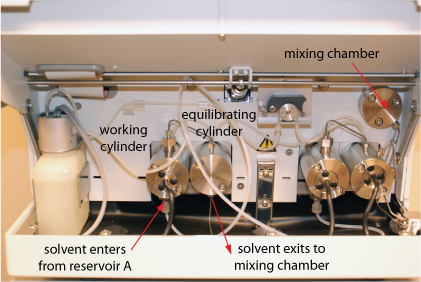
A typical HPLC includes between 1–4 reservoirs for mobile phase solvents. The mobile phase solvents are pulled from their reservoirs by the action of one or more pumps. Shown here is a close-up view of an instrument with two pumps, each consisting of a working pump and an equilibrating pump. The working pump and equilibrating pump each have a piston whose back and forth movement can maintain a constant flow rate of up to several mL/min with sufficient pressure to push the mobile phase through the chromatographic column.

During the working cylinder’s forward stoke it fills the equilibrating cylinder and establishes flow through the column. When the working cylinder is on its reverse stroke, the flow is maintained by the piston in the equilibrating cylinder, producing a pulse-free flow.
In this particular instrument, each pump sends its mobile phase to a mixing chamber where they combine to form the final mobile phase. The relative speed of the two pumps determines the mobile phase’s final composition.