
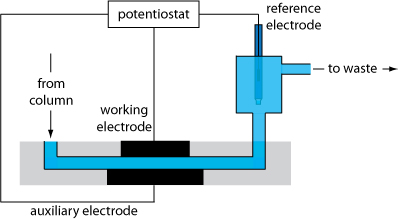
Another common group of HPLC detectors are based on electrochemical measurements such as amperometry, voltammetry, coulometry, and conductivity. The illustration below, for example, shows an amperometric flow cell. Effluent from the column passes over the working electrode, which is held at a constant potential—relative to a downstream reference electrode—that completely oxidizes or reduces the analytes. The current flowing between the working electrode and the auxiliary electrode serves as the analytical signal.
Electrochemical Detector for HPLC Separations


About the Author

David Harvey
David T. Harvey is a Professor Emeritus of Chemistry and Biochemistry at DePauw University in Greencastle, Indiana, where he has been a dedicated faculty member since 1986. Over his nearly four-decade career, Dr…
View contributions