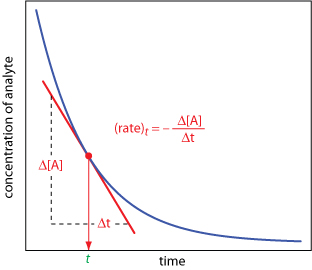
In a rate method we use the differential form of the rate law to determine the analyte’s concentration. As shown here, the rate of a reaction at time t, (rate)t, is the slope of a line tangent to a curve showing the change in concentration as a function of time.

For a reaction that is first-order in analyte, the rate at time t is
(rate)t = k[A]t = k[A]0e–kt
If we measure the rate at a fixed time, then both k and e–ktt are constant and we can use a calibration curve of (rate)t versus [A]0 for the quantitative analysis of the analyte.