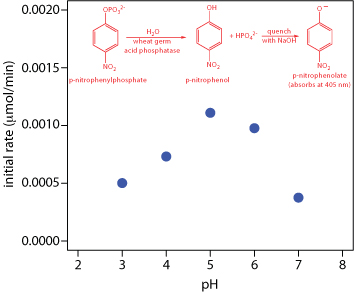
Monitoring a kinetic reaction is straight-forward, provided that the reaction does not proceed to a appreciable extent during the time it takes to make an individual measurement. As you might expect, this requirement places a serious limitation on a kinetic method of analysis. If the reaction’s kinetics are slow relative to the analysis time, then we can make our measurements without the analyte undergoing a significant change in concentration. When the reaction’s rate is too fast—which often is the case—then we introduce a significant error if our analysis time is too long.
One solution to this problem is to stop, or quench the reaction by adjusting experimental conditions. For example, many reactions show a strong pH dependency, and may be quenched by adding a strong acid or a strong base. The illustration below shows a typical example for the enzymatic analysis of p-nitrophenylphosphate using the enzyme wheat germ acid phosphatase to hydrolyze the analyte to p-nitrophenol. The reaction has a maximum rate at a pH of 5. Increasing the pH by adding NaOH quenches the reaction and converts the colorless p-nitrophenol to the yellow-colored p-nitrophenolate, which absorbs at 405 nm.