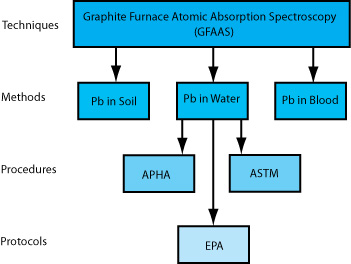
Suppose you are asked to develop an analytical method to determine the concentration of lead in drinking water. How would you approach this problem? To provide a structure for answering this question, it is helpful to make a distinction among four levels of analytical methodology: techniques, methods, procedures, and protocols.

A technique is any chemical or physical principle we can use to study an analyte. There are many techniques for determining the concentration of lead in drinking water, once of which is graphite furnace atomic absorption spectroscopy (GFAAS).
A method is the application of a technique for a specific analyte in a specific matrix. As shown above, the GFAAS method for determining lead in water is different from that for lead in soil or blood.
A procedure is a set of written directions telling us how to apply a method to a particular sample, including information on obtaining samples, handling interferents, and validating results. A method may have several procedures as each analyst or agency adapts it to a specific need. As shown above, the Environmental Protection Agency (EPA), the American Public Health Agency (APHA) and the American Society for Testing Materials (ASTM) publish separate procedures for determining the concentration of lead in water.
Finally, a protocol is a set of stringent guidelines specifying a procedure that an analyst must follow if an agency is to accept the results. Protocols are common when the result of an analysis supports or defines public policy. When determining the concentration of lead in water under the Safe Drinking Water Act, for example, labs must use a protocol specified by the Environmental Protection Agency. The flowchart shown here

provides the EPA’s protocol for the determination of trace metals, including lead, in drinking water.