To measure volumes accurately and precisely, analytical chemists use volumetric pipets and volumetric flasks. A volumetric pipet is the choice when needing to deliver a specific volume. The photo below shows two types of volumetric pipets. The pipet on the top is a transfer pipet and the pipet on the bottom is a Mohr measuring pipet. The transfer pipet delivers a single volume of 10.00 mL when filled to its calibration mark. The Mohr pipet has a mark every 0.1 mL, allowing for the delivery of variable volumes. It also has additional graduations at 11 mL, 12 mL, and 12.5 mL.
 A volumetric flask is the choice when needing to prepare a solution of known volume. When filled to its calibration mark a volumetric flask containing less than 100 mL is generally accurate to the hundredth of a mL, whereas larger volumetric flasks are accurate to the tenth of a mL.
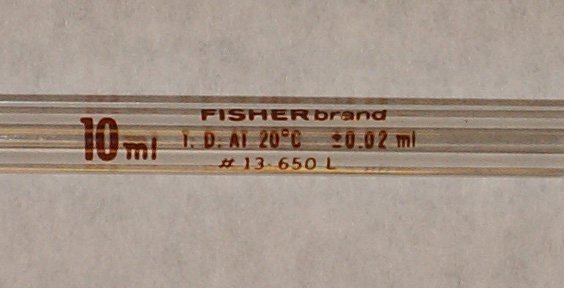
 Finally, if you look closely at a volumetric pipet or volumetric flask you will see markings similar to those shown here.

The text of the markings, which reads
10 mL T. D. at 20 oC ±0.02 mL
indicates that this pipet is calibrated to deliver (T. D.) 10 mL of solution with an uncertainty of ±0.02 mL at a temperature of 20 oC. The temperature is important because glass expands and contracts with changes in temperatures. At higher or lower temperatures, the pipet’s accuracy is less than ±0.02 mL.