
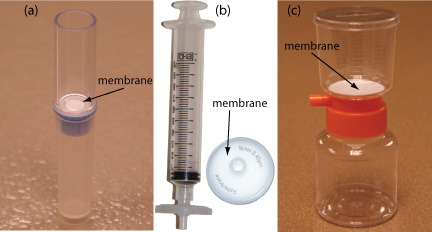
Three types of membrane filters are used to separate an analyte from interfering species that may be present in the sample solution. Figure (a) shows a centrifugal filter for concentrating and desalting macromolecular solutions. The membrane has a nominal molecular weight cut-off of 1 × 10⁶ g/mol. The sample is placed in the upper reservoir and the unit is placed in a centrifuge. Upon spinning the unit at 2000×g–5000×g, the filtrate collects in the bottom reservoir and the retentate remains in the upper reservoir. Figure (b) shows a 0.45 μm membrane syringe filter; the image on the right shows the membrane filter in its casing and the image on the left shows the filter attached to a syringe. Samples are placed in the syringe and pushed through the filter, and the filtrate is collected in a test tube or other suitable container. Figure (c) shows a disposable filter system with a 0.22 μm cellulose acetate membrane filter. The sample is added to the upper unit and vacuum suction applied to draw the filtrate through the membrane and into the lower unit. To store the filtrate, the top half of the unit is removed and a cap placed on the lower unit. The filter unit shown here has a capacity of 150 mL.
Membrane Filtration


About the Author

David Harvey
David T. Harvey is a Professor Emeritus of Chemistry and Biochemistry at DePauw University in Greencastle, Indiana, where he has been a dedicated faculty member since 1986. Over his nearly four-decade career, Dr…
View contributions