In Nessler’s original colorimetric method for ammonia, developed in the 1850s before the advent of spectrophotometers, the sample and several standard solutions of ammonia are placed in separate tall, flat-bottomed tubes. As shown in the illustration below, after adding the reagents and allowing the color to develop, the analyst evaluated the color by passing natural, ambient light through the bottom of the tubes and looking down through the solutions. By matching the sample’s color to that of a standard, the analyst was able to determine the concentration of ammonia in the sample.

If there is only one absorbing species, then this approach to determining the analyte’s concentration is not a problem. If two components in the sample absorbs different wavelengths of light, however, then a quantitative analysis using Nessler’s original method becomes impossible. Ideally we want to select a wavelength that only the analyte absorbs. Unfortunately, we can not isolate a single wavelength of radiation from a continuum source. As shown in illustration below, any method for selecting a wavelength actually passes a narrow band of radiation characterized by a nominal wavelength, an effective bandwidth, and a maximum throughput of radiation. The effective bandwidth is defined as the width of the radiation at half of its maximum throughput.

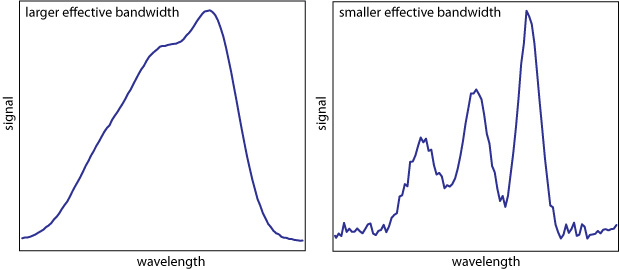
The ideal wavelength selector has a high throughput of radiation and a narrow effective bandwidth. A high throughput is desirable because more photons pass through the wavelength selector, producing a stronger signal with less background noise. A narrow effective bandwidth provides a higher resolution, with spectral features separated by more than twice the effective bandwidth being resolved. As shown in the illustration below, these two features of a wavelength selector generally are in opposition (both spectra are from the same sample). Conditions favoring a higher throughput of radiation usually provide less resolution. Decreasing the effective bandwidth improves resolution, but at the cost of a noisier signal. For a qualitative analysis, resolution is usually more important than noise, and a smaller effective bandwidth is desirable. In a quantitative analysis less noise is usually desirable.