The energy of ultraviolet and visible electromagnetic radiation is sufficient to cause a change in an atom’s valence electron configuration. Sodium, for example, has a single valence electron in its 3s atomic orbital. As shown here, unoccupied, higher energy atomic orbitals also exist. Absorption of a photon is accompanied by the excitation of an electron from a lower-energy atomic orbital to an orbital of higher energy. Not all possible transitions between atomic orbitals are allowed. For sodium the only allowed transitions are those in which there is a change of ±1 in the orbital quantum number (l); thus transitions from s → p orbitals are allowed, and transitions from s → d orbitals are forbidden.

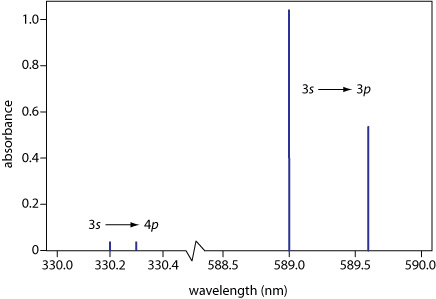
The atomic absorption spectrum for Na is shown here, and is typical of that found for most atoms. The most obvious feature of this spectrum is that it consists of a small number of discrete absorption lines corresponding to transitions between the ground state (the 3s atomic orbital) and the 3p and 4p atomic orbitals. Absorption from excited states, such as the 3p → 4s and the 3p → 3d transitions shown above, are too weak to detect. Because an excited state’s lifetime is short—typically an excited state atom takes 10–7 to 10–8 s to return to a lower energy state—an atom in the exited state is likely to return to the ground state before it has an opportunity to absorb a photon.

Another feature of the atomic absorption spectrum shown above is the narrow width of the absorption lines, which is a consequence of the fixed difference in energy between the ground and excited states. Natural line widths for atomic absorption, which are governed by the uncertainty principle, are approximately 10–5 nm. Other contributions to broadening increase this line width to approximately 10–3 nm.