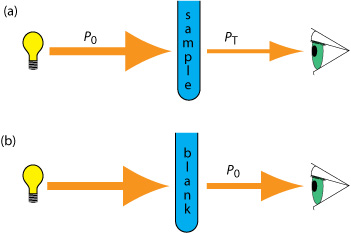
As light passes through a sample, its power decreases as some of it is absorbed. This attenuation of radiation is described quantitatively
T = PT/Po
where T is transmittance and PT and Po are, respectively, the source radiation’s power exiting the sample and that incident on the sample from the light source, as shown by (a) in the following illustration.

Unfortunately, this equation does not distinguish between different mechanisms that might prevent a photon emitted by the source from reaching the detector. In addition to absorption by the analyte, several additional phenomena may contribute to the attenuation of radiation, including reflection and absorption by the sample’s container, absorption by other components in the sample’s matrix, and scattering of radiation. To compensate for this loss of the source radiation’s power, we use a method blank. As shown by (b) in the illustration above, we redefine Po as the power exiting the method blank.