
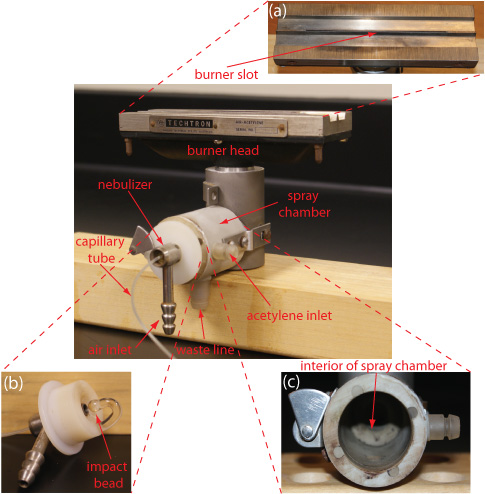
The photos below shows a typical assembly for flame atomization with close-up views of several key components. In the unit shown here, the sample is drawn into the assembly by passing a high-pressure stream of compressed air past the end of a capillary tube immersed in the sample. When the sample exits the nebulizer it strikes a glass impact bead (inset c), converting it into a fine aerosol mist within the spray chamber (inset b). The aerosol mist is swept through the spray chamber by the combustion gases—compressed air and acetylene in this case—to the burner head (inset a) where the flame’s thermal energy desolvates the aerosol mist to a dry aerosol of small, solid particles. The flame’s thermal energy then volatilizes the particles, producing a vapor consisting of molecular species, ionic species, and free atoms. The burner head provides a long optical pathlength and a stable flame. Because absorbance increases linearly with the path length, a long path length provides greater sensitivity. A stable flame minimizes uncertainty due to fluctuations in the flame.
Atomizer for Flame Atomic Absorption Spectroscopy


About the Author

David Harvey
David T. Harvey is a Professor Emeritus of Chemistry and Biochemistry at DePauw University in Greencastle, Indiana, where he has been a dedicated faculty member since 1986. Over his nearly four-decade career, Dr…
View contributions