
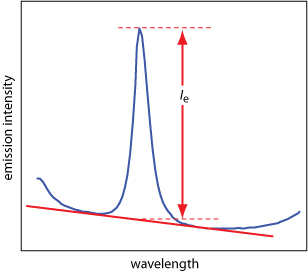
The most important spectral interference in emission spectroscopy is broad, background emission from the flame or plasma, and emission bands from molecular species. This background emission is particularly severe for flames because the temperature is insufficient to break down refractory compounds, such as oxides and hydroxides. As shown here, background corrections for flame emission are made by scanning over the emission line, drawing a baseline, and measuring emission intensity relative to this baseline.
Background Corrections in Emission Spectroscopy


About the Author

David Harvey
David T. Harvey is a Professor Emeritus of Chemistry and Biochemistry at DePauw University in Greencastle, Indiana, where he has been a dedicated faculty member since 1986. Over his nearly four-decade career, Dr…
View contributions