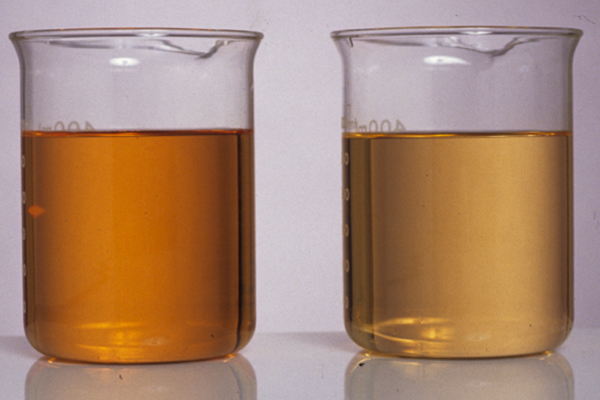
The effect of a inert salt on a reaction’s equilibrium position is shown by the solutions in these two beakers. The beaker on the left contains equal volumes of 1.0 mM FeCl3 and 1.5 mM KSCN. The solution’s color is due to the formation of the metal–ligand complex Fe(SCN)2+. Adding 10 g of KNO3 to the beaker on the left produces the result shown on the right. The lighter color suggests that there is less Fe(SCN)2+ as a result of the equilibrium reaction shifting to the left.
Fe3+(aq) + SCN–(aq) ↔ Fe(SCN)2+(aq)

Why should adding an inert electrolyte affect a reaction’s equilibrium position? We can explain the effect of KNO3 on the formation of Fe(SCN)2+ by considering the reaction on a microscopic scale. The solution in the beaker on the right contains a variety of cations and anions—Fe3+, SCN–, K+, NO3–, H3O+, and OH–. Although the solution is homogeneous, on average, there are slightly more anions in regions near Fe3+ ions, and slightly more cations in regions near SCN– ions. As shown in this figure

each Fe3+ ion and SCN– ion is surrounded by an ionic atmosphere of opposite charge (δ– and δ+) that partially screen the ions from each other. Because each ion’s apparent charge at the edge of its ionic atmosphere is less than its actual charge, the force of attraction between the two ions is smaller. As a result, the formation of the Fe(SCN)2+ is slightly less favorable and the formation constant for the equilibrium reaction is slightly smaller. Higher concentrations of KNO3 increase δ– and δ+, resulting in even smaller values for the formation constant.