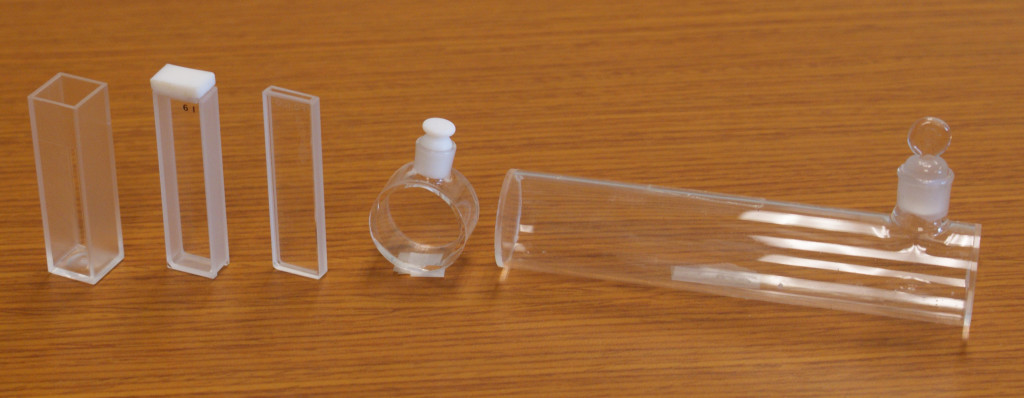
The photo below shows several examples of sample cells for UV/Vis spectroscopy. From left to right (with path lengths in parentheses): rectangular plastic cuvette (10.0 mm), rectangular quartz cuvette (5.000 mm), rectangular quartz cuvette (1.000 mm), cylindrical quartz cuvette (10.00 mm), cylindrical quartz cuvette (100.0 mm). These cells often are available as a matched pair, which is important when using a double-beam instrument.

This photo shows a typical fiber-optic probe, which allows for the analysis of samples in situ. The probe consists of two bundles of fiber-optic cable. One bundle transmits radiation from the source to the probe’s tip, which is designed to allow the sample to flow through the sample cell. Radiation from the source passes through the solution and is reflected back by a mirror. The second bundle of fiber-optic cable transmits the nonabsorbed radiation to the wavelength selector. The inset photographs provide a close-up look at the probe’s flow cell and the reflecting mirror.

This photo shows three examples of IR sample cells: (a) a set of NaCl salts plates; (b) a fixed pathlength (0.5 mm) sample cell with NaCl windows; and (c) a disposable card with a polyethylene window that is IR transparent with the exception of strong absorption bands at 2918 cm–1 and 2849 cm–1.