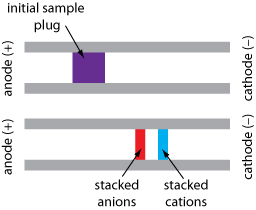
When a analyte’s concentration is too small to detect reliably, it may be possible to introduce it in a manner that increases its concentration in the capillary tube. This method of injection is called stacking.
Stacking is accomplished by placing the sample in a solution whose ionic strength is significantly less than that of the buffer in the capillary tube. Because the sample plug has a lower concentration of buffer ions, the effective field strength across the sample plug is larger than that in the rest of the capillary. As a result, cations in the sample plug migrate toward the cathode with a greater velocity and the anions migrate more slowly—neutral species are unaffected and move with the electroosmotic flow. When the ions reach their respective boundaries between the sample plug and the buffering solution, the electrical field decreases and the electrophoretic velocity of cations decreases and that for anions increases. As shown here, the result is a stacking of cations and anions into separate, smaller sampling zones.

As the separation proceeds, the buffer within the capillary becomes more homogeneous and the separation proceeds without additional stacking.